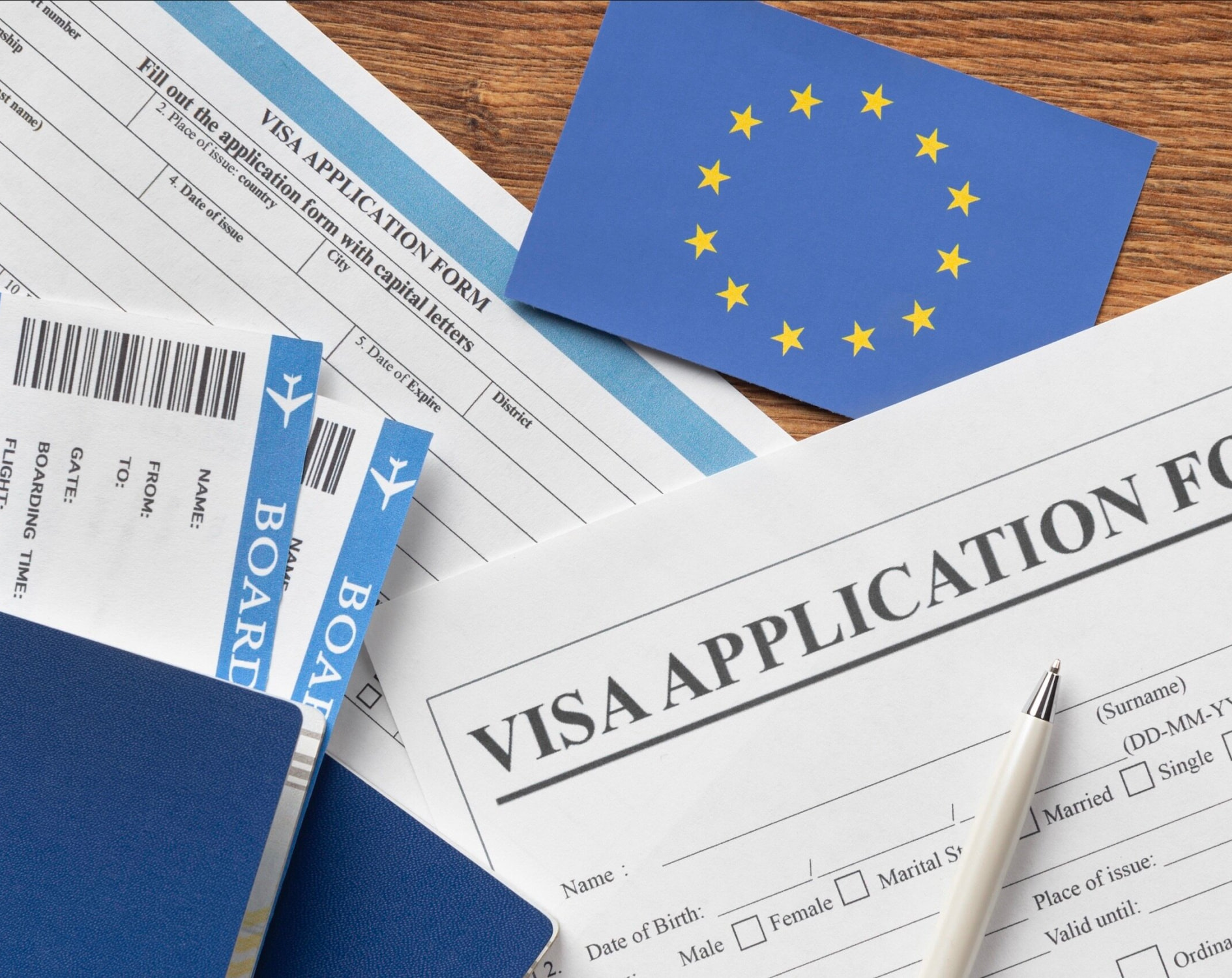
South African citizens need a Schengen visa to enter Europe, and holding a UAE residence visa does not change that requirement. A South African passport holder living in Dubai or Abu Dhabi applies through the Schengen consulate responsible for the UAE, not through South Africa. This guide explains who needs the visa, which country to apply to, what documents a UAE resident must submit, what the Schengen visa costs, how long processing takes, and how to book an appointment in Dubai or Abu Dhabi.
Quick summary
South African citizens need a Schengen Type C visa for short stays of up to 90 days in any 180-day period. A South African passport holder resident in the UAE applies in the UAE, not in South Africa. The adult fee is €90, processing takes 15 calendar days in standard cases, and applications should be submitted 6–8 weeks before travel.
| Question | Answer |
| Do South African citizens need a Schengen visa? | Yes. South Africa is listed in Annex I of Regulation (EU) 2018/1806, so a Schengen short-stay visa is required. |
| What visa type applies? | Schengen Type C, short stay, valid for up to 90 days in any 180-day period. |
| What is the adult fee? | The Schengen visa fee is €90 per adult applicant, in force since 11 June 2024. |
| How long does processing take? | Standard processing is 15 calendar days from the date the consulate receives an admissible application. |
| Where do UAE residents apply? | A South African passport holder resident in the UAE applies at the consulate of the main destination Schengen state in Dubai or Abu Dhabi. |
| When should you apply? | Apply 6–8 weeks before travel, and no earlier than 6 months before departure. |
| What passport validity is required? | The passport must be issued within the last 10 years, valid at least 3 months beyond the intended departure date from the Schengen Area, and contain at least 2 blank pages. |
Do South African citizens need a Schengen visa?
South African citizens need a Schengen visa because South Africa sits on Annex I of Regulation (EU) 2018/1806, the list of nationalities subject to the visa requirement. The correct visa is a Schengen Type C short-stay visa, which permits stays of up to 90 days in any 180-day period. The same visa covers tourism, business travel and family visits.
The visa requirement applies to South African passport holders regardless of where they live. A South African citizen resident in the UAE needs the visa just as a South African citizen resident in South Africa does. Residence changes where the application is submitted, not whether a visa is required.
Many South African travellers assume that a relatively strong passport gives visa-free access to Europe. It does not. The Schengen Area requires a visa for this nationality, and the absence of a visa at the border results in denied entry.
What your UAE residence changes — and what it does not
A UAE residence visa does not remove the Schengen visa requirement for South African citizens, but it changes where the application is submitted and what evidence supports it. Nationality determines whether a visa is required; residence determines which consulate has jurisdiction. A South African passport holder living in the UAE applies in the UAE, not in South Africa.
A stable UAE residence position strengthens the application file. A valid UAE residence visa, an Emirates ID, a long-term employment contract, a salary certificate, a tenancy contract and six months of UAE bank statements together demonstrate that the applicant has ties to the UAE and a reason to return. Consulates assess whether the applicant is likely to leave the Schengen Area before the visa expires, and a well-documented UAE residence record supports that assessment.
Which Schengen country should you apply to?
You must apply to the Schengen state that is your main destination, meaning the country where you will spend the most nights during the trip. Where nights are split equally between two or more states, you apply to the state of first entry. Applying to the wrong consulate is a refusal ground, not a formality.
The main destination rule applies to every Schengen application. A consulate that receives an application for a trip centred on another member state can refuse to process it or refuse the visa outright. The rule is set out in the Visa Code and is applied consistently across consulates in the UAE.
Applying for a multi-country trip
Consider a ten-night trip that starts in Paris, continues to Amsterdam for four nights, and ends in Berlin for three nights. France receives the first three nights, the Netherlands receives four nights, and Germany receives three nights. The Netherlands is the main destination because it accounts for the most nights, so the application goes to the Netherlands consulate.
If the same trip gives France four nights, the Netherlands four nights and Germany two nights, no single state holds the most nights. In that case the application goes to the state of first entry, which is France.
Not sure which country to apply to?
Contact our team
Documents for a Schengen visa for UAE residents
The core document set for a Schengen visa application from the UAE includes the following items:
Passport. Issued within the last 10 years, valid at least 3 months beyond the intended departure date from the Schengen Area, with at least 2 blank pages. A passport that fails any of these conditions cannot be used for the application.
UAE residence visa and Emirates ID. Both must be valid at the time of application. Most consulates require the residence visa to remain valid for at least 3 months beyond the return date.
Completed application form. The form must be signed and consistent with the supporting documents. Errors in dates or destination details create inconsistency.
Photograph. A recent biometric photograph that meets Schengen specifications.
Travel medical insurance. Cover of at least €30000, valid across all Schengen states for the full duration of the trip.
Flight and accommodation reservations. Reservations must match the itinerary declared in the application and the consulate’s main destination assessment.
Bank statements. Six months of UAE bank statements showing regular income and sufficient balance for the trip.
Employment or business evidence. A salary certificate and employment letter for employees, or a trade licence and company documents for business owners.
Documents South African applicants are commonly asked for on top of the core set
Consulates assessing a South African passport holder resident in the UAE frequently request evidence of ties to the UAE rather than to South Africa. A tenancy contract, a salary certificate, six months of UAE bank statements and an employer no-objection certificate together show that the applicant lives and works in the UAE and will return.
Where children travel, consulates frequently request unabridged birth certificates and parental consent documents. Requirements vary by consulate and change over time, so verify the current requirement with the relevant consulate before submitting the application. Do not rely on a blanket rule.

Aleksei, visa consultant at The Visa Services:
“South African applicants often submit a file that is technically complete but reads as generic. Every document is there, yet nothing explains why this particular person is travelling now, to these cities, for this many nights. A consulate officer reviews hundreds of files a week — the ones that get approved without hesitation are the ones where the itinerary, the bank activity and the employment letter tell the same coherent story. Completeness gets you past the front desk; coherence gets you the visa.”
Our team prepares your full Schengen application in Dubai
Contact our team
Fees and processing times
The Schengen visa fee is €90 per adult applicant and €45 for children aged 6 to 11. Children under 6 are exempt from the visa fee. Additional costs include the visa application centre service charge, courier fees, optional services and travel medical insurance. The visa fee is non-refundable regardless of the outcome.
| Fee item | Amount |
| Adult visa fee | €90 |
| Child visa fee (6–11) | €45 |
| Child visa fee (under 6) | Free |
| Visa application centre service charge | Varies by centre |
| Travel medical insurance | Varies by provider |
| Total for one adult applicant | €90 plus service charge and insurance |
Standard processing takes 15 calendar days from the date the consulate receives an admissible application. Processing may extend to 45 calendar days where further checks are required. Apply 6–8 weeks before travel, and allow more time during the summer peak season.
| Processing stage | Timeframe |
| Standard decision | 15 calendar days from receipt of an admissible application |
| Extended decision | Up to 45 calendar days where further checks are needed |
| Recommended application window | 6–8 weeks before travel |
| Earliest application | 6 months before travel |
| Latest application | No later than 15 calendar days before departure |
How to apply for a Schengen visa from the UAE, step by step
- Choose the correct consulate. Identify the Schengen state of the main destination, meaning the country where you will spend the most nights. Where nights are equal, choose the state of first entry. Applying to the wrong consulate is a refusal ground.
- Complete the application form. Enter personal details, passport details, itinerary and accommodation information exactly as they appear in the supporting documents. Sign the form.
- Book the appointment. Book a slot at the visa application centre or consulate responsible for your main destination. Appointment wait times run from 1 to 4 weeks in peak season, so book as early as the application window allows.
- Assemble the documents. Prepare the passport, UAE residence visa, Emirates ID, application form, photograph, insurance, flight and accommodation reservations, bank statements and employment evidence. Add the documents required for children if they are travelling.
- Attend the appointment and give biometrics. Fingerprints and a facial image are collected at the appointment. Previously enrolled biometrics can be reused for 59 months. The decision is issued from 15 calendar days after the consulate receives an admissible application, and may take up to 45 calendar days.
- Pay the fees. Pay the €90 adult visa fee or the €45 child fee, plus the visa application centre service charge and any optional services. The visa fee is non-refundable.
- Track the application. Use the reference number issued at the appointment to track the application status online or through the visa application centre.
- Collect the passport. Collect the passport with the visa decision from the visa application centre. Check that the visa dates, number of entries and territory covered match the trip.
General information about Schengen visa processing in great detail in this article.
Where to apply in Dubai and Abu Dhabi
Schengen consulates in the UAE operate across Dubai and Abu Dhabi, and the consulate responsible for your main destination determines which location handles the application. Some consulates accept applications at a visa application centre in Dubai, while others require attendance in Abu Dhabi. The appointment itself involves document submission, biometric enrolment and payment.
Appointment slots in peak season fill quickly. Book as soon as the application window opens, which is 6 months before travel. Applying late leaves no room to correct a missing document or a booking error.

A strong passport, but Europe still needs a visa
The South African passport gives visa-free or visa-on-arrival access to a large number of destinations, and that is exactly why many travellers are caught out by Europe. The Schengen Area is not among the visa-free destinations for South African citizens.
The UK route and the Schengen route are separate. A UK visa does not permit entry to the Schengen Area, and a Schengen visa does not permit entry to the UK. The two applications involve different authorities, different fees and different document sets.
ETIAS does not apply to South African citizens. ETIAS is a travel authorisation for visa-exempt nationals, and South African passport holders are not visa-exempt for the Schengen Area. ETIAS is not an alternative to a Schengen visa.
| Feature | Schengen visa | ETIAS |
| Who it is for | Nationals subject to the visa requirement, including South African citizens | Visa-exempt nationals only |
| What it is | A visa issued by a Schengen consulate | A travel authorisation linked to a passport |
| Fee | €90 per adult applicant | Not applicable to South African citizens |
| Biometrics | Fingerprints and facial image collected at the appointment | Not applicable to South African citizens |
| Does it apply to you? | Yes | No |
EES, ETIAS and what changed in 2026
The EU Entry/Exit System has been fully operational since 10 April 2026, replacing passport stamping with a biometric record at the border. The system records the date and place of entry and exit, and overstays are logged automatically.
What to do if you are only transiting through the Schengen Area
An airport transit visa (Type A) is not always required. If you are flying through an airport in the Schengen Area without leaving the international transit zone, and you remain there only to change flights, you may not need a separate transit visa. For South African citizens, there is generally no mandatory airport transit visa requirement when transiting through Schengen airports, provided you remain airside.
There is one important exception. If your connection requires you to collect your baggage and check it in again, change airports within the Schengen Area, or pass through border control, the standard Type A transit visa will not cover you. In that case, a regular short-stay Schengen Type C visa is required, as for a full entry.
The rule is simple: if you remain in the sterile transit zone of a single airport, a separate visa is usually not needed. If you cross the Schengen border in any form, a full Schengen visa is required.
Why applications are refused — and how
to avoid it
A refusal is issued on a standard form that states the reasons. We have compiled a list of common refusal reasons for you.
- Wrong consulate. Apply to the main destination — the state with the most nights, or the first entry point where nights are equal.
- Weak financial evidence. Submit six months of UAE bank statements and a salary certificate that matches the deposits.
- Insurance below the minimum. A policy under €30000 makes the application inadmissible.
- Unclear purpose of travel. Flight and accommodation reservations must match the declared purpose and dates.
- Weak ties to the UAE. Submit a tenancy contract, employment letter and employer no-objection certificate.
- Applying too late. Apply 6–8 weeks before travel to leave room for checks and corrections.
Why apply for a Schengen visa through The Visa Services?
Applying for a Schengen visa is a standard procedure, but nevertheless it requires very careful preparation. We know the UAE very well. We understand the specifics of submitting documents through local visa centres and what visa officers usually pay attention to when reviewing documents. Our visa experts know how to prepare a convincing application, even if family members have passports from different countries, you need a visa urgently, or you have recently received a refusal.
Planning Europe? Apply now – we handle the paperwork
Contact our team
Do South African citizens holding a dual citizenship need a visa for the Schengen Area?
Dual citizenship can change your visa situation, depending on your second nationality. If you are a South African citizen and also a citizen of a country with visa-free access to the Schengen Area, you may travel on that country’s passport and may not need a visa. South African citizens whose second nationality does not carry visa-free access still need a Schengen visa.
Can South Africans travel to Europe visa-free?
No. South African citizens cannot travel to the Schengen Area visa-free. The South African passport gives visa-free or visa-on-arrival access to many destinations, but the Schengen Area is not one of them.
Can I apply for a Schengen visa from Dubai on a South African passport?
Yes. A South African passport holder resident in the UAE applies in the UAE at the consulate of the main destination Schengen state. The application is submitted in Dubai or Abu Dhabi depending on the consulate responsible for the main destination.
What documents do South African citizens need for a Schengen visa?
South African citizens need a passport, a UAE residence visa and Emirates ID, a completed application form, a photograph, travel medical insurance of at least €30,000, flight and accommodation reservations, six months of bank statements and employment or business evidence. Consulates commonly request a tenancy contract, salary certificate and employer no-objection certificate as evidence of ties to the UAE.
Do South Africans need a transit visa?
If your route involves a transit through the Schengen Area with a step outside the sterile zone, you apply for a standard Schengen visa through the consulate of the country where your transit stop occurs.
How long does a Schengen visa take from the UAE?
Standard processing takes 15 calendar days from the date the consulate receives an admissible application. Processing may extend to 45 calendar days where further checks are required. Apply 6–8 weeks before travel.
Do South African children need extra documents for a Schengen visa?
Consulates frequently request unabridged birth certificates and parental consent documents for children travelling from the UAE. Requirements vary by consulate and change over time, so verify the current requirement with the relevant consulate before submitting the application.
Is a UK visa the same as a Schengen visa?
No. A UK visa does not permit entry to the Schengen Area, and a Schengen visa does not permit entry to the UK. The two routes involve different authorities, different fees and different applications.
This material is informational and is not legal or immigration advice. All information on visa application rules is set out in the Visa Code. Visa decisions rest with the consulate of the Schengen state concerned. Fees, document lists and processing times change — verify them on official sources before you apply.