




Quick Summary: Yes, Indian citizens need a visa to visit the UK for tourism, business, or study purposes. The most common option is the Standard Visitor visa, which allows stays up to 6 months. Indian passport holders cannot enter the UK visa-free and must apply online before traveling.
Planning a trip to the UK from the UAE? Whether it’s exploring London’s historic landmarks, attending business meetings in Manchester, or visiting family across the British Isles, understanding visa requirements is the first critical step.
The short answer is: Indian passport holders cannot enter the UK without a visa. Unlike citizens from certain countries who enjoy visa-free travel or electronic travel authorization options, Indians must obtain proper documentation before departure.
But here’s what you need to know: the process isn’t as complicated as it might seem, and understanding the requirements upfront can save significant time and frustration.
Understanding UK Visa requirements for Indian сitizens
According to the UK government’s official guidance, Indian nationals traveling on ordinary passports require a visa to enter the United Kingdom for any purpose — tourism, business visits, short-term study, or medical treatment. The UK does not have visa waiver agreements with India for ordinary passport holders.
This requirement applies regardless of how long you plan to stay. Even a brief layover that involves passing through UK immigration control requires appropriate documentation.
The Standard Visitor visa: your primary option
For most Indian travelers, UAE residents, the Standard Visitor visa is the appropriate choice. This visa category covers a broad range of permitted activities, making it the most versatile option for short-term visits.
You can visit the UK as a Standard Visitor for tourism, business activities, study courses up to 6 months, and other permitted activities. The standard duration allows stays of up to 6 months, though you might be able to apply for longer periods in certain circumstances, such as receiving medical treatment.
Real talk: the Standard Visitor visa handles the vast majority of travel scenarios Indians encounter when visiting the UK.
When Indian citizens don’t need a UK visa
There are extremely limited situations where Indian nationals might not need a separate visa. These exceptions are narrow and specific.
Holders of diplomatic or official passports may qualify for visa exemptions under bilateral agreements between India and the UK. However, these arrangements apply only to government officials traveling on official business, not ordinary travelers.
If you’re transiting from the UAE through the UK without passing through immigration control — meaning you stay airside in the international transit area—you typically don’t need a transit visa. But this applies only if you’re not entering the UK officially.
That said, certain nationalities require a Direct Airside Transit visa even for airport connections. Indian citizens generally do not need this for simple connections, but checking current requirements is essential if you have a layover exceeding 24 hours or need to collect and recheck baggage.
Types of UK visas available to Indian nationals
While the Standard Visitor visa covers most short-term travel, understanding the full range of visa categories helps match your specific purpose with the correct application.
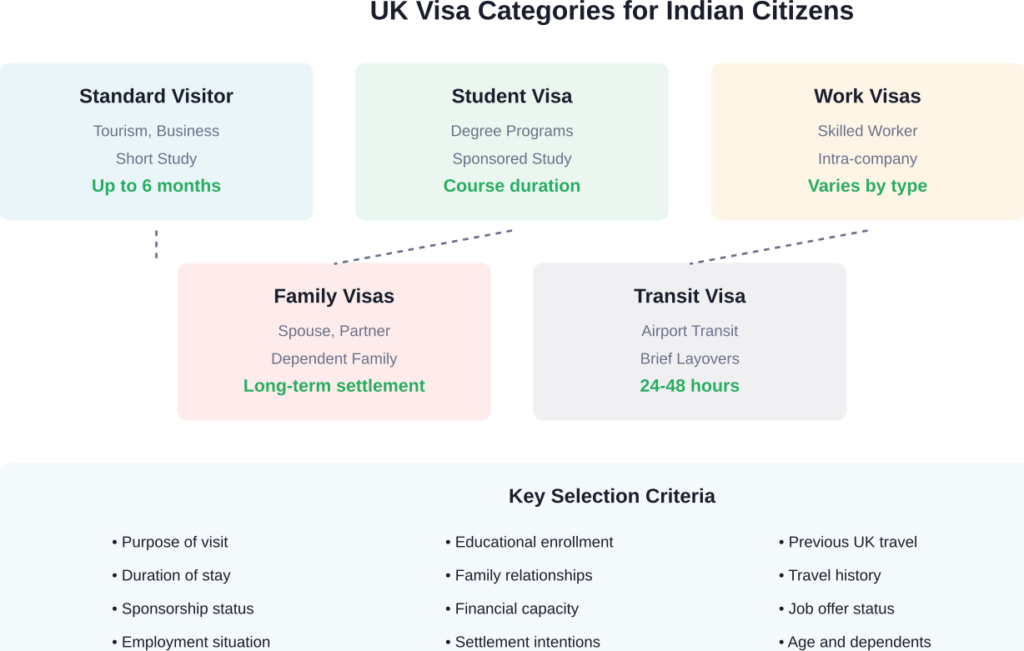
Visitor visas details
The UK offers several visitor visa options, each with different validity periods. Choosing the right one depends on how often you plan to travel.
The Standard Visitor visa permits various activities including general tourism, visiting friends and family, conducting business meetings and conferences, private medical treatment, and participating in short-term study programs up to 6 months.
What you cannot do on a Standard Visitor visa: work for a UK company, access public funds, marry or register a civil partnership, or stay beyond your visa’s expiration date.
Student visas
Indian students planning to pursue degree-level education or longer courses at UK institutions need a Student visa. This requires sponsorship from a licensed educational institution and proof of financial capacity to support yourself.
Work-related visas
Several work visa categories exist for Indian professionals, including the Skilled Worker visa for those with job offers from UK sponsors, the Intra-company Transfer visa for employees being transferred to UK branches, and specialized visas for healthcare workers, ministers of religion, and creative professionals.
Family and settlement visas
Indian citizens with family members in the UK may qualify for family visas, including spouse or partner visas, dependent child visas, or parent visas under specific circumstances.
The UK Visa application process for Indians
Applying for a UK visa involves several structured steps. Understanding this process helps avoid common mistakes that delay applications.
Here’s the thing though — the UK does not offer visa-on-arrival or electronic visas for Indian citizens. You must complete the entire application process before traveling.
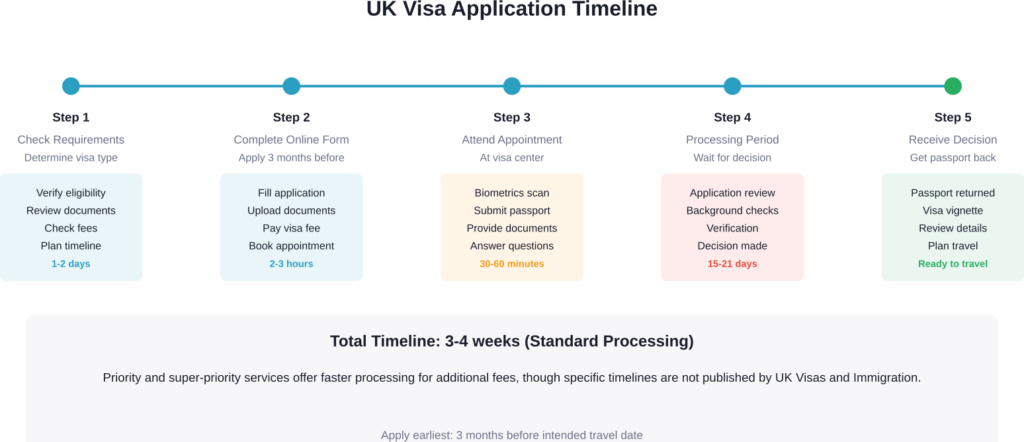
Step-by-step timeline for UK visa application process from the UAE
Step 1: Determine your visa type
Start by identifying which visa category matches your travel purpose. The UK government provides an online tool to check visa requirements based on nationality and travel purpose.
Step 2: Complete the online application
If you need a Standard Visitor visa, you must apply online before traveling to the UK. The earliest you can apply is 3 months before your intended travel date.
The online form requires detailed information about your travel plans, financial situation, employment status, and travel history. Accuracy is crucial—inconsistencies can lead to delays or refusals.
Step 3: Pay the visa fee
Visa fees must be paid online during the application process. Fees vary depending on visa type and duration. Check the official UK government website for current pricing, as fees change periodically and may differ based on exchange rates.
Step 4: Book and Attend Your Appointment
After completing the online application, you’ll need to attend an appointment at a visa application centre.
As a UAE resident holding an Indian passport, you are entitled to apply from Dubai, Abu Dhabi, or any emirate where you have a valid residence visa. The UK Home Office processes applications based on your country of usual residence — and that is the UAE.
Where to apply in Dubai and Abu Dhabi: Biometrics are taken at UK visa application centres operated in the UAE. The Dubai centre is located in Wafi Mall, with additional centres in Abu Dhabi, Sharjah, Al Ain, and Ajman.
Step 5: Wait for processing
Standard processing typically takes around 15-21 days from the date of your biometrics appointment. Priority and super-priority services offer faster processing for additional fees, though specific timelines are not published by UK visas and immigration.
Required documents for UK visa application
Documentation requirements depend on your visa type, but certain documents are universally necessary for Indian applicants.
| Document category | Specific requirements | Purpose |
|---|---|---|
| Passport | Valid for entire stay plus additional validity; blank pages for visa | Primary identification and travel document |
| Financial evidence | Bank statements (6 months), payslips, tax returns, sponsorship letters | Prove ability to support yourself financially |
| Accommodation proof | Hotel bookings, invitation letters from hosts, rental agreements | Demonstrate where you’ll stay |
| Travel Itinerary | Flight bookings, detailed travel plans, return tickets | Show clear travel intentions |
| Employment documents | Employer letter, leave approval, business registration if self-employed | Prove ties to the UAE and employment status |
| Previous travel | Old passports, previous visas, travel stamps | Establish positive travel history |
For business visitors, additional documents include invitation letters from UK companies, details of business meetings or conferences, and evidence of business activities in the UAE.
Students need acceptance letters from educational institutions, proof of payment for courses, and evidence of accommodation arrangements.
Sound familiar? The UK visa process emphasizes demonstrating genuine intent and financial stability.
Fees and processing times from the UAE
All fees are set by the UK Home Office and are the same worldwide. The following table reflects current charges from 2026.
| Service | Fee (GBP) | Approx. (AED) |
|---|---|---|
| Standard Visitor (6 months) | £135 | ≈ 665 |
| Priority service (extra) | £500 | ≈ 2350 |
| Super Priority service (extra) | £1000 | ≈ 4700 |
Processing times
- Standard: about 3 weeks (15 working days) from biometrics
- Priority: about 5 working days (target)
- Super Priority: next working day (subject to availability)
During peak seasons, appointment availability may extend timelines, so plan at least 6–8 weeks ahead. Fees are non-refundable if the application is refused.
Common reasons for UK visa rejection
Understanding common rejection reasons helps applicants strengthen their applications and avoid preventable mistakes.
Insufficient financial evidence tops the list. Applicants must demonstrate they can afford the trip and will not work illegally or access public funds. Bank statements showing consistent income and adequate savings carry significant weight.
Weak ties to the UAE represent another major concern. Immigration officials assess whether applicants will return after their visit. Strong ties include stable employment, property ownership, family responsibilities, and ongoing business or educational commitments.
Incomplete or inconsistent documentation raises red flags. Missing documents, unexplained gaps in employment or travel history, or contradictory information between different documents often lead to refusals.
Previous immigration violations in any country negatively impact applications. Overstaying previous visas, working without authorization, or providing false information creates serious credibility issues.
Poor travel history — particularly first-time travelers with no prior international travel—sometimes faces additional scrutiny, though this alone shouldn’t cause rejection if other factors are strong.
Why an ETA is not an option for an Indian passport
A common and costly mistake is confusing the UK Electronic Travel Authorisation with a visitor visa. The ETA is only for nationals who do not need a visa to enter the UK, including Emirati citizens.
As an Indian passport holder, you cannot apply for an ETA. The fee of £20 does not apply to you, and attempting to travel without the correct visa will result in being denied boarding. Always apply for the full Standard Visitor visa through the official gov.uk portal.
The ETA is designed for visa-exempt nationals only — so stick with the visa route that matches your passport.
Transit visa requirements
Transit situations require careful attention. If you’re passing from the UAE through the UK en route to another destination, whether you need a visa depends on specific circumstances.
You typically won’t require a transit visa if you have certain valid visas or permits, including an EU Settlement Scheme family permit, a Home Office travel document for refugees or stateless persons, or a valid Standard Visitor visa.
If you’re transiting airside without passing through UK immigration control, and your layover doesn’t require collecting and rechecking baggage, you may not need a visa. But if your layover exceeds 48 hours or you need to officially enter the UK, proper authorization becomes necessary.
We covered the transit visa requirements for Indian citizens in detail in this article.
Cost considerations for Indian travelers
Budget planning should account for multiple expenses beyond the base visa fee.
| Expense Type | Description |
|---|---|
| Visa application fee | Base cost for Standard Visitor visa; varies by visa type and duration |
| Priority processing | Optional expedited service for faster decisions |
| Document translation | If documents aren’t in English, certified translations required |
| Travel to visa centre | Transportation and accommodation if centre isn’t in your city |
| Document preparation | Obtaining bank statements, notarizations, invitation letters |
| Travel insurance | Recommended for all international travel |
Check the official UK government website for current visa fees, as prices adjust periodically.
Tips for a successful UK visa application
Maximizing approval chances requires strategic preparation and attention to detail.
Apply early. Don’t wait until the last minute. Applying three months before travel provides buffer time if additional documents are requested or processing takes longer than expected.
Be honest and consistent. Provide truthful information throughout the application. Lies or inconsistencies—even minor ones—can result in automatic rejection and future bans.
Demonstrate strong ties to the UAE. Employment letters, property documents, family commitments, and ongoing responsibilities all strengthen your case for returning.
Show clear travel purpose. Vague or unconvincing travel plans raise suspicions. Detailed itineraries, confirmed bookings, and specific reasons for visiting demonstrate genuine intent.
Organize documentation meticulously. Well-organized, clearly labeled documents make reviewing your application easier for immigration officers. Include cover letters explaining your situation if circumstances are complex.
Ensure financial documents are recent. Bank statements should be current—typically within the last month. Dated financial evidence loses credibility.
Consider professional assistance for complex cases. Immigration lawyers or registered migration agents can help navigate complicated situations, though they’re not necessary for straightforward tourist applications.
If you are unsure about any document, have a complex situation (freelance, multiple citizenships, recent job change, or dependent visa), or simply want to maximise your approval chances, The Visa Services offers professional guidance tailored to Indian passport holders in Dubai. Our team reviews your documents, helps prepare the cover letter, and ensures your bank statement meets consulate expectations.
Need fast, professional visa assistance?
Contact our team
Understanding your rights and responsibilities
Visa holders must understand both what they’re permitted to do and what’s prohibited under their visa conditions.
Standard Visitor visa holders can enjoy tourism, visit family and friends, attend business meetings and conferences, participate in sports or creative events (without being paid by UK organizations), and undertake short-term study.
What you absolutely cannot do: work for a UK company or as self-employed, claim benefits or public funds, marry or register a civil partnership, or overstay your permitted duration.
Violating visa conditions carries serious consequences including deportation, future entry bans, and potential criminal charges depending on the violation’s nature.
After receiving your visa
Once approved, carefully review all visa details before traveling.
Check the visa dates — both when you can enter the UK and how long you can stay. These aren’t always identical. The visa vignette in your passport shows when you’re permitted to enter, while the permitted stay duration may be specified separately.
Verify that all personal details are correct. Spelling errors in your name or incorrect passport numbers can cause significant problems at border control.
Understand the difference between single-entry and multiple-entry visas if applicable. Some visas allow multiple trips within the validity period, while others permit only one entry.
Keep copies of all application documents when traveling. Immigration officers at UK airports may ask to see supporting evidence matching your visa application. For instructions on how to download your UK eVisa, see this article.
FAQ
Can Indian citizens visit the UK without a visa?
No. Indian passport holders require a visa to enter the UK for any purpose, including tourism, business, or study. The UK does not offer visa-free entry or visa-on-arrival for Indian nationals traveling on ordinary passports.
How long does it take to get a UK visa from the UAE?
Standard processing takes about 3 weeks from biometrics. Priority service targets 5 working days; Super Priority targets the next working day.
How far in advance can I apply for a UK visitor visa?
The earliest you can apply is 3 months before your planned travel date. This timeline applies to Standard Visitor visas and most other visa categories for Indian applicants.
What is the validity period of a UK Standard Visitor visa?
Standard Visitor visas typically allow stays of up to 6 months. The visa may be issued as single-entry or multiple-entry depending on your circumstances and application. Some applicants may qualify for longer validity periods covering multiple trips over several years, though each individual stay still cannot exceed 6 months.
Do I need a transit visa if I’m only changing flights in the UK?
It depends on your specific circumstances. If you remain airside in the international transit area without passing through UK immigration control, you typically don’t need a transit visa. However, if you need to collect baggage, change terminals, or officially enter the UK during your layover, appropriate visa authorization is required.
Can my UK visa application be rejected even if I provide all documents?
Yes. Providing all required documents doesn’t guarantee approval. Immigration officers assess multiple factors including financial stability, ties to the UAE, travel history, and overall credibility. Applications can be refused if officials aren’t convinced you’ll comply with visa conditions or return to the UAE after your visit.
What should I do if my UK visa application is rejected?
Carefully review the rejection letter explaining the refusal reasons. You can apply again, addressing the concerns raised in the refusal. Alternatively, you may request an administrative review if you believe the decision was based on incorrect information or procedural errors. Reapplying with the same documentation without addressing rejection reasons typically results in another refusal.
This article is for informational purposes only and does not constitute legal or immigration advice. Visa decisions are made solely by the Entry Clearance Officer. Fees, processing times, and rules may change — always verify current requirements on the official gov.uk website before submitting your application.