
If you are an Indian citizen living in Dubai or elsewhere in the UAE, obtaining a Schengen visa is a realistic and well‑defined process. In 2026 Indians form the single largest group of Schengen applicants from the UAE. However, success depends on precise documentation, a clear financial picture, and avoiding routine errors. This guide covers everything you need to know: documents, the bank statement requirements, common mistakes, approval rates by country, and practical tips to strengthen your application.
Can Indian Citizens in Dubai Apply for a Schengen Visa?
Yes. Indian passport holders legally residing in the UAE can apply for a Schengen visa at the consulate or visa application centre of their main European destination. The essential condition is a valid UAE residence visa (employment visa is strongest; dependent visa is also acceptable). Tourist or visit visa holders in the UAE generally cannot apply from Dubai — they must apply from their country of residence.
Schengen visa documents for Indian passport holders: full checklist
Below is the complete document checklist. Pay special attention to the cover letter and bank statement — they are the most frequently questioned items.
| Document | India‑specific notes |
| Passport (valid 3+ months after return, at least 2 blank pages) | Old passports with previous visas (including expired Schengen visas) are a strong plus. |
| UAE residence visa (valid 3+ months after return) | Employment visa is preferred. Dependent/sponsor visas are acceptable with sponsor’s documents. |
| Emirates ID (original + copy) | Must match the residence visa details exactly. |
| Schengen visa application form (signed) | Fill online, print, and sign by hand. One copy per applicant. |
| Two recent photos (35×45 mm, light background, ≤6 months old) | Do not reuse old photos even if you look similar. |
| Flight booking (return) | Unpaid or refundable booking is fine; do not buy tickets before approval. |
| Hotel reservation (for all nights) | Ensure the booking does not auto‑cancel after 72 hours. |
| Travel medical insurance (€30,000 minimum, valid across all Schengen states) | Policy must explicitly state “Schengen” and cover emergency repatriation. |
| Employment letter / NOC (with position, length of service, salary, approved leave) | Must match your bank statement credits exactly — see salary split issue below. |
| Bank statement (6 months recommended, stamped) | Detailed requirements in the next section. |
| Cover letter (explaining itinerary, costs, ties to UAE) | Critical for first‑time applicants or complex travel plans. |
| Previous Schengen visas (copies) | If available, attach even expired ones — they build a reliable traveller profile. |
Mandatory documents
Every applicant must provide the following without exception:
- Passport
- UAE residence visa
- Emirates ID
- Application form
- Two recent photos
- Flight + hotel bookings
- Travel medical insurance
- Employment letter / NOC
- Bank statement
Financial documents: bank statement & employment letter
Your employment letter and bank statement must tell the same story. In the UAE, many Indian professionals receive a split salary: basic salary + housing allowance + transport allowance. Each component may be credited separately or even from different accounts. The visa officer needs to see that all these credits together match the total stated in your employment letter.
Key requirement: If your employment letter says AED 15 000 per month, your bank statement must show total monthly credits of approximately AED 15 000. Any unexplained gap or extra credit will raise questions.
Schengen visa bank statement requirements for Indians in Dubai
The Schengen visa bank statement is arguably the most scrutinised document. Consulates want proof that you can cover trip costs and that you have no financial incentive to overstay.
| Requirement | Detail |
| Minimum closing balance | AED 20 000 – 30 000 recommended (for a 10–14 day trip) |
| Statement period | 6 months (3 months is the absolute minimum, but 6 months is safer) |
| Recency | Printed within 7–10 days of submission |
| Format | Official bank letterhead with stamp; English preferred |
| Regular credits | Salary deposits should appear consistently each month |
| Red flag | Large unexplained cash deposits shortly before submission |
How to handle the UAE split salary issue
Ask your HR department for a salary breakdown letter showing basic pay and each allowance. Then highlight the corresponding credit entries on your bank statement. If allowances are paid in cash, transfer them to your account immediately upon receipt and maintain a log. Alternatively, attach a simple table:
*“Basic salary AED 8 000 (credit 01.03.2026), Housing AED 5 000 (credit 02.03.2026), Transport AED 2 000 (credit 02.03.2026) = Total AED 15 000 as per employment letter.”*
The сash deposit red flag
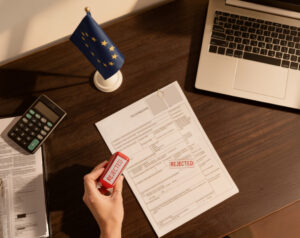
Unexplained cash deposits are one of the common mistakes leading to refusal. If a visa officer sees AED 10 000 deposited in cash one week before submission, they will suspect it is borrowed money that may disappear after the visa is issued. Solution: Use only salary credits and regular savings transfers. If you must deposit cash, wait at least 3–4 months before applying, or add a clear explanation in your cover letter.
Common mistakes that lead to Schengen Visa rejection for Indians
Based on real refusal data from UAE visa application centres, these are the most frequent errors among Indian applicants.
- Salary mismatch between employment letter and bank statement credits (the №1 problem for Indian professionals in Dubai).
- Large unexplained cash deposits shortly before applying.
- Weak cover letter — generic, too short, or missing key points (purpose, costs, ties to UAE).
- No travel history — first‑time Schengen applicants should start with a shorter, well‑planned trip.
- Overambitious itinerary — trying to visit 8 countries in 7 days; consulates see this as unrealistic.
- Invalid or insufficient travel insurance — policies that do not explicitly cover all Schengen states or lack emergency repatriation.
- Inconsistent dates — flight, hotel, and leave approval dates do not align.
- Applying too late — less than 15 working days before travel; the application may be rejected as “too close to travel.”
Salary mismatch between employment letter and bank credits
This is the most common rejection reason for Indian passport holders in Dubai. The solution is straightforward: before submitting, compare your employment letter total with the sum of all salary‑related credits in your bank statement for each month. If they differ, ask your employer for a corrected letter or add a cover letter explaining the difference (e.g., AED 1 000 per month is reimbursed separately in cash for mobile and internet).
Schengen visa approval rates for Indians from Dubai by country
Approval rates vary significantly between consulates. Below are estimates based on internal data from authorised submission centres and industry reports (2024–2026).
| Schengen Country | Approval Rate (Indians from UAE) | Standard Processing Time |
| Czech Republic | ~96% | 10–12 working days |
| Finland | ~95% | 10–15 working days |
| Portugal | ~94% | 12–15 working days |
| Spain | ~91% | 10–15 working days |
| Germany | ~88% | 12–18 working days |
| Italy | ~87% | 10–15 working days |
| France | ~85% | 12–20 working days |
| Denmark | ~83% | 15–20 working days |
Important: The “easiest” consulate still requires a complete and truthful application. Do not apply to a country simply because its approval rate is higher — always apply to the country where you will spend the most nights.
Schengen visa fees & processing time from Dubai 2026
| Applicant Category | Fee |
| Adults (12 years and above) | EUR 90 (approx. AED 370–390) |
| Children aged 6–12 | EUR 45 (approx. AED 185–200) |
| Children under 6 | Free |
Processing time: Standard is 10–15 working days. In peak seasons (March–September, December–January), it can extend to 4–6 weeks. Recommended lead time: apply 8 weeks before your planned departure.
Need Professional Assistance?
If you are unsure about any document, have a complex situation (freelance, multiple citizenships, recent job change, or dependent visa), or simply want to maximise your approval chances, The Visa Services offers professional guidance tailored to Indian passport holders in Dubai. Our team reviews your documents, helps prepare the cover letter, and ensures your bank statement meets consulate expectations.
This article provided a very detailed explanation of obtaining a Schengen visa from Dubai and Abu Dhabi.
There is no official minimum, but a monthly salary below AED 8 000–12 000 is considered higher risk. More important than the salary figure is the consistency of your bank statement credits and a sufficient closing balance (AED 20 000+).
Officially, 3 months. However, 6 months is strongly recommended because it better demonstrates regular income and reduces suspicion of recent large deposits.
Based on approval rates, Czech Republic (~96%), Finland (~95%), and Portugal (~94%) have the highest approval rates for Indian applicants in the UAE. Nevertheless, always apply to the country that is your main destination.
Yes, but it is less common. First‑time applicants typically receive a single‑entry visa valid for the exact trip dates. After one or two compliant trips, the cascade regime (effective since 2024) makes you eligible for a two‑year, then a five‑year multiple‑entry visa.
The salary mismatch between the employment letter and bank statement credits, caused by the UAE split‑salary structure. Always document each component and ensure the total matches.