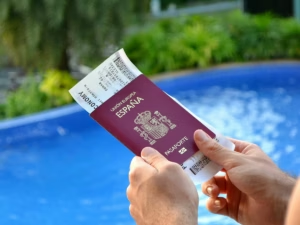
Every year, hundreds of thousands of Spaniards travel to the United States for holidays, business meetings, or to study. Most of them never need to apply for a traditional visa. However, this doesn’t mean that everyone can simply hop on a plane with just a passport and ESTA.
In this guide, we explain clearly when Spanish citizens can enter the USA visa-free, and when they must obtain a proper U.S. visa.
Can Spanish Citizens Travel to the USA Without a Visa?
The short answer is: Yes, in most cases, but only for short stays of up to 90 days.
Spain has been part of the Visa Waiver Program (VWP) since 1991. This special agreement allows Spanish passport holders to enter the United States for tourism, visiting family, or business purposes without applying for a visa in advance.
To use this benefit, two things are required. The first is a valid Spanish biometric passport (with electronic chip), and the second is a pre-approved ESTA authorization.
If both conditions are met, most travelers can enjoy 90 days in the USA without ever visiting an embassy.
How the ESTA System Works for Spaniards
ESTA stands for Electronic System for Travel Authorization. It is not a visa, but an electronic permission to travel under the Visa Waiver Program.
Once approved, your ESTA is usually valid for two years or until your passport expires, whichever comes first. During this period, you can enter the United States multiple times, as long as each stay does not exceed 90 days.
Important things to know:
- You must apply for ESTA before boarding your flight or ship to the USA.
- Approval is usually given within minutes, but it can sometimes take up to 72 hours.
- The current cost is $40.27 USD (as of 2026).
- You need to pay this fee for each new ESTA application.

When a Spanish Citizen Actually Needs a U.S. Visa
Even though Spain participates in the Visa Waiver Program, there are several situations where ESTA cannot be used and a visa becomes mandatory.
Here are the most common scenarios:
- You want to stay in the USA longer than 90 days.
- You plan to study in the United States (even short programs sometimes require it).
- Your ESTA application has been denied.
- You have been arrested or convicted of certain crimes (even minor ones).
- You hold dual nationality with Cuba, Democratic People’s Republic of Korea, Iran, Iraq, Sudan, or Syria.
- You have traveled to or been present in Cuba (on or after January 12, 2021), Democratic People’s Republic of Korea, Iran, Iraq, Libya, Somalia, Sudan, Syria, or Yemen on or after March 1, 2011 (with very few exceptions for diplomatic or military purposes in the service of a VWP country).
In any of these cases, you must apply for a regular visa in the U.S. Embassy in Madrid.

Ready to Skip the US Visa Hassle? Let The Visa Services Handle It
At The Visa Services, we’ve helped thousands of travelers sort out their US trips, including many who run into the usual headaches – long waits for appointments or tricky paperwork when ESTA isn’t an option. We’ve been doing this for over eight years now, with more than 20,000 visas processed and solid 4.7-star feedback on Google.
For anyone who needs a full US visa instead of just ESTA, whether it’s a tourist stay longer than 90 days, a business trip that requires more structure, or a student visa, we step in to make things smoother. We handle document checks, form filling, itinerary setup, and booking those hard-to-get embassy slots.
Our urgent US visa service can get things moving in as little as a few weeks for priority cases, and renewals often take around three weeks or so. We focus only on guiding you legally and professionally, so that you can avoid stress and effort.
Which US Visa Do Spanish Citizens Actually Need?
Below is a clearer look at the three main visa types Spanish citizens apply for when ESTA is not enough.
Tourist Visa: B-2 for Longer or Special Visits
The B-2 visa is the traditional tourist visa. Most Spanish travelers only consider it when their trip does not qualify for the Visa Waiver Program. That usually happens if they plan to stay longer than 90 days, if their ESTA application was denied, or if their travel history makes them ineligible for visa free entry.
With a B-2 visa, stays can be granted for up to six months at a time, depending on the decision made at the port of entry. In certain situations, extensions are possible. This visa is commonly used for extended tourism, visiting family for a longer period, or receiving medical treatment in the United States.
Business Visa: B-1 for Professional Activities
The B-1 visa is meant for temporary business related travel. It covers activities such as attending conferences, holding meetings, negotiating contracts, or taking part in short term training, as long as no salary is paid by a US employer.
It is important to understand that this visa does not authorize employment in the United States. You cannot work for a US company or receive payment from one under B-1 status. While many Spanish professionals can still use ESTA for brief business visits, longer stays or more complex professional arrangements often require applying for a B-1 visa instead.
Student Visa: F-1 for Full-Time Studies
Anyone planning to study full time in the United States will almost always need an F-1 student visa. This applies even to language programs if they last more than a short period and lead to structured academic instruction.
To qualify, you must first be accepted by a school that is approved under the Student and Exchange Visitor Program. The institution will issue Form I-20, which is required for the visa application. You will also need to show proof that you can financially support yourself during your stay and attend an interview at the US Embassy in Madrid.
ESTA cannot be used for formal study that leads to a degree or certificate. Once your plans move beyond tourism or short business visits, the F-1 visa becomes the correct and necessary path.
Common Reasons ESTA Gets Denied for Spanish Applicants
Over the past few years, certain patterns have emerged for Spanish citizens facing ESTA refusals:
- Previous travel to restricted countries (especially Iran, Syria, Iraq).
- Dual nationality issues.
- Previous visa violations or overstay history in the USA.
- Criminal records (even old or minor ones).
- Intentions that appear to go beyond 90 days.
If your ESTA is denied, you generally cannot reapply, you must go through the full visa application process instead.
How to Apply for a U.S. Visa from Spain
When a visa is required, the process usually follows these steps:
- Complete the DS-160 online application form.
- Pay the visa application fee.
- Schedule an appointment at the U.S. Embassy in Madrid.
- Attend the visa interview (in English or Spanish).
- Wait for your passport to be returned with the visa.
Processing times in Madrid currently vary depending on the visa type and season, but tourist and student interviews are generally available within a reasonable timeframe compared to many other countries.

Tips to Improve Your Chances of Approval
Getting approved, whether for ESTA or a full visa, comes down to being clear, honest, and prepared. Officers look for people who plan to leave the United States at the end of their stay and who have strong ties back home.
For ESTA applications, keep answers simple and accurate. Double-check your travel history, especially any trips to the Middle East or certain African countries after 2011. Even a brief layover can flag your application if it matches restricted areas.
When it comes to visa interviews, preparation makes a big difference. Bring proof of employment or studies in Spain, family or property ties, bank statements showing you can cover your trip, return flight tickets, and hotel bookings.
Many Spanish applicants get denied because they seem unsure about their plans or lack financial proof. Practice answering basic questions like “Why are you visiting the United States?” or “What do you do in Spain?” Keep responses short and confident.
One small tip that helps a lot: dress neatly for the interview. It sounds basic, but showing respect goes further than most people think.
How Long Can You Really Stay in the USA?
Under the Visa Waiver Program with ESTA, the maximum is 90 days per visit. That clock starts the moment you enter the country, and it includes any time spent in Canada, Mexico, or nearby islands if you leave and re-enter the United States.
CBP officers at the border decide your exact allowed stay – usually 90 days, but sometimes less if they have concerns. Overstaying even by a day can block future ESTA use and force you into the visa process next time.
For B-1 or B-2 visas, the initial stay is often six months, but extensions are possible if you have a good reason (like medical treatment). Student visas (F-1) allow you to stay for the full length of your program plus a short grace period – typically 60 days after completion.
The key rule remains the same: never plan to live or work in the United States on these short-term options. Immigration officers are trained to spot intent that goes beyond tourism, business meetings, or study.
Final Advice for Spanish Travelers
The system works well for most people from Spain. The Visa Waiver Program saves time and hassle compared to full visa applications in many other countries. Stick to the rules – apply early, be honest, and show clear plans to return home – and the vast majority of trips go smoothly.
If your situation feels complicated (dual passport, past travel issues, or long stays), don’t risk it with ESTA. Head straight to the embassy process. Better to spend a few extra weeks preparing than face a denial at the gate.
Planning a trip to the States? Start with ESTA if it fits your plans. It’s quick, costs about $40, and opens the door to everything from New York weekends to California road trips. Safe travels.
FAQ
No. Once the 90 days are up, you must leave North America (including Canada and Mexico) for a significant period before returning. Trying to “border hop” rarely works and can lead to future denials.
Your ESTA is only for entry. As long as you entered with a valid one, you can stay until your admitted date expires. But don’t try to re-enter without renewing it first.
Yes, every traveler, including babies, needs one. Parents apply on their behalf using the child’s passport details.
No. The final decision happens at the border with a CBP officer. They can still ask questions and, in rare cases, refuse entry.
Your Spanish passport, ESTA approval (print it or have it on your phone), and proof of onward travel if asked.