Quick Summary: Yes, Iraqi citizens need a visa to visit the USA. Iraq is not part of the Visa Waiver Program, so all Iraqi nationals must apply for the appropriate U.S. visa type before traveling—whether for tourism, business, study, or other purposes. The application process involves submitting a DS-160 form, paying visa fees, and attending an interview at a U.S. Embassy or Consulate.
Traveling to the United States from Iraq requires careful preparation and understanding of visa requirements. Unlike citizens from certain countries who can travel visa-free under the Visa Waiver Program, Iraqi nationals must obtain a visa before entering American territory.
This isn’t just bureaucratic red tape. The visa requirement exists for security and immigration management purposes, and understanding the process can save you time, money, and potential disappointment at the airport.
Let’s break down what Iraqi citizens need to know about visiting the United States in 2026.
Understanding U.S. Visa Requirements for Iraqi Citizens
Iraq is not included in the U.S. Visa Waiver Program, which means every Iraqi citizen—regardless of their travel purpose—must apply for and receive a visa before boarding a flight to America.
This applies even if you hold dual citizenship with an Iraqi passport. According to the State Department, applicants of Iraqi nationality may face different reciprocity arrangements even when applying from other countries where they hold permanent residence.
Why Iraq Isn’t Part of the Visa Waiver Program
The Visa Waiver Program allows citizens from certain countries to travel to the United States for tourism or business for stays of 90 days or less without obtaining a visa. Iraq doesn’t qualify for this program due to several factors including security considerations and bilateral agreements.
The program has specific requirements that participating countries must meet, and Iraq currently doesn’t fulfill these criteria.
Recent Policy Changes Affecting Iraqi Nationals
According to the U.S. Embassy in Iraq, effective January 21, 2026, the Department of State paused all immigrant visa issuances to nationals of countries whose immigrants have a high rate of collecting public assistance at the expense of the U.S. taxpayer. This pause affects immigrant visas specifically.
However, nonimmigrant visas—used for temporary visits like tourism, business, and study—continue to be processed for Iraqi applicants. This distinction matters because most Iraqi visitors seeking to travel to the United States will apply for nonimmigrant visas.
Types of Visas Available to Iraqi Citizens
The United States offers multiple visa categories depending on your purpose of travel. Choosing the correct visa type is essential because applying for the wrong category can result in denial and wasted fees.
B-1/B-2 Visitor Visas
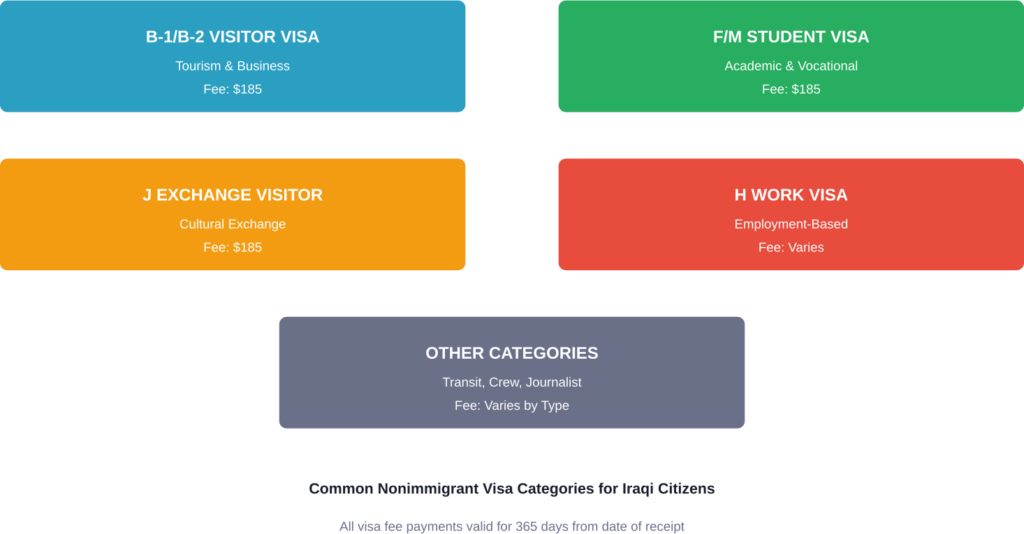
The B visa category is the most common for Iraqi citizens planning short-term visits to the United States. The B-1 visa covers business activities, while the B-2 covers tourism, medical treatment, and visits to friends or family.
According to the U.S. Embassy in Baghdad, the fee for visitor visas is $185. This fee must be paid in U.S. dollars at any Bank of Baghdad branch for each applicant.
These visas typically allow stays of up to six months, though the exact duration is determined by the immigration officer at your port of entry.
Student Visas (F and M)
Iraqi students accepted to U.S. educational institutions need either an F visa (academic studies) or M visa (vocational training). The application fee is $185, matching the visitor visa cost.
Student visas require additional documentation including an I-20 form from your school, proof of financial resources, and evidence of ties to Iraq that demonstrate your intent to return after completing your studies.
Exchange Visitor Visas (J)
The J visa facilitates cultural exchange programs, including au pairs, summer work travel, and academic exchanges. Like student visas, J visas require sponsorship from an approved program and carry a $185 application fee.
Work Visas and Other Categories
Iraqi citizens offered employment in the United States will need a work visa, with the specific category depending on the job type and duration. These petition-based visas have varying fees and requirements beyond the standard nonimmigrant application process.
Other specialized categories exist for journalists, diplomatic personnel, crew members, and transit passengers.
The Visa Application Process for Iraqi Citizens
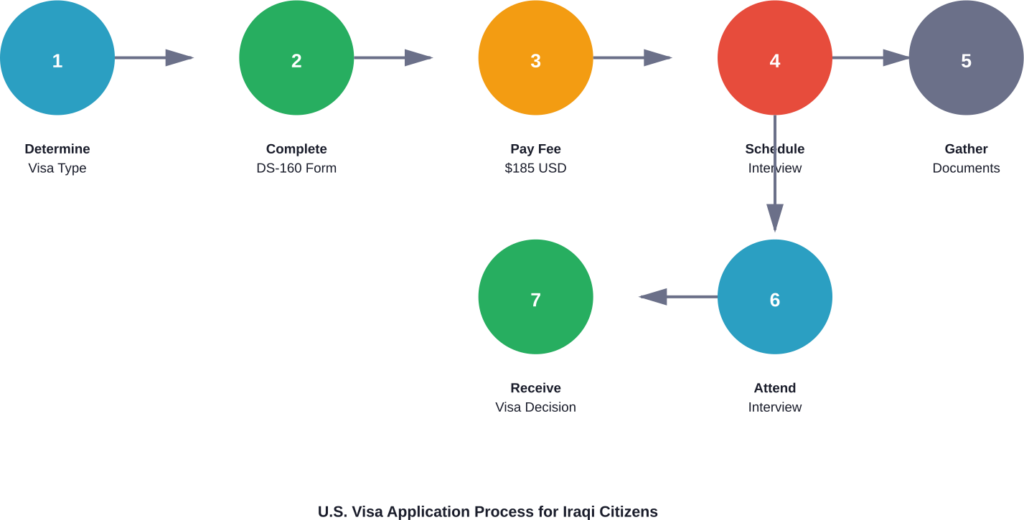
Applying for a U.S. visa from Iraq involves several steps that must be completed in order. Skipping steps or providing incomplete information will delay your application or result in denial.
Step 1: Determine Your Visa Type
Before starting any paperwork, identify the correct visa category for your travel purpose. The State Department provides a Visa Wizard tool to help applicants determine which visa type they need.
Choosing the wrong category is one of the most common mistakes. A tourist visa won’t work if you’re attending a conference, and a business visa won’t suffice for enrolling in a degree program.
Step 2: Complete the DS-160 Form
The DS-160 is the online nonimmigrant visa application form required for all temporary travel to the United States. This comprehensive form collects biographical information, travel plans, and background details.
Save your application frequently—the system times out after 20 minutes of inactivity. Once submitted, you’ll receive a confirmation page with a barcode that you must bring to your interview.
Step 3: Pay the Visa Application Fee
All nonimmigrant visa application fee payments made on or after October 1, 2022, are valid for 365 days from the date the receipt is issued for payment. For Iraqi applicants, payments can be made in U.S. dollars at any Bank of Baghdad branch.
The fee for visitor, student, exchange visitor, and other non-petition-based visas is $185. Keep your payment receipt—you’ll need it to schedule your interview.
Step 4: Schedule Your Visa Interview
Iraqi applicants must schedule interviews at either the U.S. Embassy in Baghdad or the U.S. Consulate in Erbil. Interview wait times vary throughout the year, so book as early as possible once you’ve paid your fee.
Some applicants report that appointment availability can be limited, with wait times potentially extending several months during peak travel seasons.
Step 5: Gather Required Documents
Before your interview, compile all necessary documentation. While requirements vary by visa type, most applicants need:
- Valid Iraqi passport with at least six months validity beyond your intended stay
- DS-160 confirmation page with barcode
- Visa application fee payment receipt
- Passport-style photograph meeting U.S. specifications
- Supporting documents proving the purpose of your trip
- Evidence of ties to Iraq (employment, property, family)
- Financial documentation showing ability to cover trip expenses
For student visas, you’ll also need your I-20 form and SEVIS fee receipt. Work visas require petition approval notices.
Step 6: Attend Your Visa Interview
The consular interview is the most critical step. A consular officer will ask questions about your travel plans, ties to Iraq, and background. Answer honestly and directly—inconsistencies or evasiveness raise red flags.
According to the U.S. Embassy in Baghdad, interview hours are 8:30 a.m. to 4:30 p.m., Sunday through Thursday. Arrive early and be prepared for security screening.
The officer will make a decision during or shortly after the interview. If approved, your passport will be returned with the visa within several days to weeks.
U.S. Embassy and Consulate Locations in Iraq
Iraqi applicants can apply for U.S. visas at two locations: the U.S. Embassy in Baghdad or the U.S. Consulate in Erbil. Both facilities provide consular services including visa interviews.
U.S. Embassy Baghdad
The main embassy facility in Baghdad processes visa applications for Iraqi citizens throughout most of the country. Security protocols are strict given the regional security situation, so expect thorough screening when entering the compound.
For visa-related inquiries, Iraqi applicants can contact the embassy through official channels listed on the embassy website. Medical examinations required for certain visa categories can be conducted through authorized physicians at IOM Baghdad, located in the International Zone.
According to the State Department, the basic medical exam fee is $160 USD for applicants 15 years and older, and $70 USD for children under 15.
U.S. Consulate Erbil
Iraqi citizens in the Kurdistan region can apply at the U.S. Consulate in Erbil. This facility serves applicants from northern Iraq and provides the same visa services as the Baghdad embassy.
IOM Erbil also offers medical examination services for visa applicants, with the same fee structure as Baghdad.
Common Reasons for Visa Denial
Not all visa applications are approved. Understanding common denial reasons helps applicants avoid mistakes and strengthen their applications.
Failure to Demonstrate Ties to Iraq
The most frequent reason for visitor visa denials is the consular officer’s belief that the applicant intends to overstay or immigrate permanently. Strong ties to Iraq—such as employment, property ownership, family relationships, or educational enrollment—help overcome this concern.
Young, single applicants without substantial assets or commitments in Iraq face higher scrutiny. Documentation proving your reasons to return is essential.
Insufficient Financial Documentation
Applicants must demonstrate they can afford their U.S. trip without working illegally or becoming a public charge. Bank statements, employment letters, and sponsor affidavits help establish financial stability.
Thin or inconsistent financial documentation raises questions about how the applicant plans to support themselves during their stay.
Incomplete or Inconsistent Information
Discrepancies between the DS-160 form and interview answers create doubts about the applicant’s credibility. Provide consistent, truthful information throughout the process.
Submitting false documents or making misrepresentations can result in permanent visa ineligibility.
Security or Background Concerns
Visa applications undergo security screening. Past immigration violations, criminal history, or connections to organizations of concern can lead to denial or administrative processing delays.
Some denials result from issues beyond the applicant’s control, such as incomplete security clearances or policy restrictions.
Special Considerations for Iraqi Dual Citizens
Iraqi citizens who also hold citizenship from a Visa Waiver Program country face unique situations. Some applicants report that even those holding dual citizenship with VWP countries have experienced ESTA application rejections due to Iraqi nationality.
In such cases, these individuals must apply for a traditional visa through the DS-160 process, even though their second passport would normally grant them visa-free travel. This results from security provisions in the Visa Waiver Program Improvement and Terrorist Travel Prevention Act.
Processing Times and Administrative Delays
Standard visa processing takes several weeks from interview to passport return with visa. However, some applications require additional administrative processing, which can extend the timeline by several weeks or months.
Administrative processing is most common for applicants requiring security clearances or additional documentation review. There’s no way to expedite this process—applicants must wait for the embassy to complete its review.
Plan your travel with substantial lead time. Booking flights before receiving your visa risks financial loss if processing takes longer than expected or if your application is denied.
Emergency Appointments and Expedited Processing
The U.S. Embassy in Baghdad offers emergency appointments for urgent situations like medical emergencies, family crises, or critical business needs. However, these are granted sparingly and require documentation proving the emergency.
Tourism plans and pre-booked vacation packages don’t typically qualify for emergency processing. Apply early rather than relying on expedited options.
ESTA and Why Iraqi Citizens Can’t Use It
The Electronic System for Travel Authorization (ESTA) allows citizens of Visa Waiver Program countries to travel to the United States without obtaining a traditional visa. Iraqi citizens cannot use ESTA because Iraq is not a Visa Waiver Program participant.
Even if an Iraqi citizen holds dual citizenship with a VWP country, having Iraqi nationality or having traveled to Iraq after March 2011 disqualifies them from ESTA eligibility under the Visa Waiver Program Improvement and Terrorist Travel Prevention Act.
| Aspect | ESTA (Not Available to Iraqis) | Traditional Visa (Required for Iraqis) |
|---|---|---|
| Application Method | Online only | Online DS-160 plus in-person interview |
| Processing Time | Usually within 72 hours | Several weeks to months |
| Cost | $21 USD | $185 USD (visitor/student visas) |
| Validity | 2 years or passport expiry | Varies by visa type and reciprocity |
| Stay Duration | Up to 90 days per visit | Determined at port of entry |
| In-Person Interview | Not required | Required for most applicants |
What Happens After Visa Approval
Once approved, your passport will be returned with the visa stamp. This visa allows you to travel to a U.S. port of entry—it doesn’t guarantee admission.
At the airport or border crossing, a Customs and Border Protection officer makes the final decision about whether to admit you and for how long. Having a valid visa is necessary but not sufficient for entry.
Visa Validity vs. Stay Duration
Your visa’s validity period indicates how long you can use it to travel to the United States. The actual duration of your stay is determined by the immigration officer at entry and marked on your I-94 arrival/departure record.
For example, a 10-year tourist visa doesn’t mean you can stay in the United States for 10 years. It means you can make multiple trips during those 10 years, with each visit typically limited to six months or less.
Traveling with Children
Iraqi parents traveling with minor children must obtain separate visas for each child. Children cannot be added to a parent’s passport for visa purposes—each traveler needs their own passport and visa.
Minors require parental consent for visa applications. If only one parent is traveling with the child, carry documentation showing the other parent’s permission for international travel.
Medical Requirements and Vaccinations
Certain visa categories require medical examinations conducted by embassy-authorized physicians. The International Organization for Migration operates facilities in both Baghdad and Erbil for these examinations.
As of the latest information from the U.S. Embassy, medical exam fees are $160 USD for applicants 15 years and older, and $70 USD for those under 15.
Vaccination requirements vary by visa type. Immigrant visas have more comprehensive vaccination requirements than nonimmigrant visas.
Costs Beyond the Visa Fee
The $185 visa application fee is just one cost. Iraqi applicants should budget for:
- Passport renewal or issuance (if needed)
- Photographs meeting U.S. specifications
- Travel to Baghdad or Erbil for the interview
- Medical examinations (if required for your visa type)
- Translation of documents not in English
- SEVIS fee for student visas ($350 USD)
- Travel insurance (recommended)
Total costs can easily reach several hundred dollars before even booking flights.
What If Your Visa Is Denied?
Visa denials are final—there’s no formal appeals process. However, applicants can reapply if their circumstances change or if they can provide additional documentation addressing the denial reasons.
The consular officer should provide the legal basis for the denial (usually citing specific sections of U.S. immigration law). Understanding this basis helps determine whether reapplication is worthwhile.
Reapplying requires paying another application fee, so ensure you’ve addressed the original concerns before submitting a new application.
Special Immigration Programs for Iraqi Nationals
Certain Iraqi nationals who worked with or on behalf of the U.S. government may qualify for special immigrant visas. According to USCIS, the National Defense Authorization Act authorizes special immigrant status for Iraqi nationals employed by the U.S. government in Iraq on or after March 20, 2003, for at least one year who have experienced or are experiencing serious threats as a consequence of that employment.
This program is separate from regular visa categories and has its own application procedures and quotas.
Additionally, USCIS has established classes of admission for surviving spouses and children of deceased Afghans and Iraqis who worked for the U.S. government, providing pathways for these family members.
Current Security Situation and Travel Advisories
The State Department maintains travel advisories for Iraq that can affect visa considerations. These advisories reflect the security environment and potential risks to travelers.
While these advisories primarily warn Americans about traveling to Iraq, they also reflect the broader security context that influences visa policy and processing for Iraqi nationals seeking to visit the United States.
Consular officers consider regional security factors when evaluating visa applications, particularly regarding the applicant’s ability to demonstrate credible return plans.
Maintaining Valid Status While in the United States
Once in the United States on a nonimmigrant visa, maintaining legal status is critical. Overstaying your authorized period—even by a single day—can result in visa cancellation and bars to future U.S. travel.
Track your stay duration using your I-94 record, available online through U.S. Customs and Border Protection. If circumstances require extending your stay, apply for an extension before your authorized period expires.
Working without authorization, attending school on a tourist visa, or otherwise violating your visa terms can result in removal and long-term consequences for future applications.
Resources and Assistance
Several resources help Iraqi applicants navigate the visa process:
- The U.S. Embassy Baghdad website provides current information on visa procedures and requirements
- The State Department’s visa information pages offer comprehensive guidance on visa categories
- The Visa Wizard tool helps determine appropriate visa types
- Authorized immigration attorneys can provide legal advice (though representation isn’t required for straightforward cases)
Be cautious of visa consultants or services promising guaranteed approval—no one can guarantee visa issuance, and the U.S. government doesn’t recognize special facilitators.
Frequently Asked Questions
No, Iraqi citizens cannot visit the USA without a visa. Iraq is not part of the Visa Waiver Program, so all Iraqi nationals must obtain the appropriate visa before traveling to the United States, regardless of the purpose or duration of their visit.
The application fee for most nonimmigrant visas—including visitor (B-1/B-2), student (F/M), and exchange visitor (J) visas—is $185 USD. This fee must be paid in U.S. dollars at any Bank of Baghdad branch. Additional costs may include medical examinations and other documentation expenses depending on the visa type.
Processing times vary significantly. After the interview, standard processing typically takes several weeks. However, some applications require administrative processing, which can extend the timeline by several additional weeks or months. Interview appointment availability also affects the overall timeline, with wait times varying throughout the year.
The application process combines online and in-person components. The DS-160 form is completed online, and fees can be paid at designated banks. However, most Iraqi visa applicants must attend an in-person interview at the U.S. Embassy in Baghdad or the U.S. Consulate in Erbil—purely online processing isn’t available for Iraqi nationals.
Visa denials are final with no formal appeals process. However, applicants can reapply if circumstances change or if they can provide additional documentation addressing the denial reasons. Reapplication requires paying another application fee. The consular officer should indicate the legal basis for denial, which helps determine whether reapplication is appropriate.
Yes, every traveler needs their own visa, including children. Iraqi parents cannot add children to their passports for visa purposes. Each minor must have their own passport and must submit a separate visa application with parental consent.
Generally no. Even if an Iraqi citizen holds citizenship from a Visa Waiver Program country, having Iraqi nationality or having traveled to Iraq after March 2011 typically disqualifies them from ESTA eligibility under the Visa Waiver Program Improvement and Terrorist Travel Prevention Act. These individuals must apply for traditional visas through the DS-160 process.
Conclusion
Iraqi citizens do need a visa to visit the United States—there’s no exception to this requirement. The process involves completing a DS-160 form, paying the $185 application fee, gathering supporting documents, and attending an in-person interview at a U.S. Embassy or Consulate in Iraq.
While the process requires time, effort, and careful preparation, thousands of Iraqi nationals successfully obtain U.S. visas each year for tourism, study, business, and family visits. Understanding the requirements and preparing thoroughly significantly improves approval chances.
Start your application well in advance of planned travel. Gather comprehensive documentation demonstrating your ties to Iraq and ability to finance your trip. Answer all questions honestly and consistently.
The visa in your passport opens doors to opportunities in the United States—whether reconnecting with family, pursuing education, conducting business, or experiencing American culture. With proper preparation and realistic expectations, Iraqi citizens can navigate the visa process successfully and begin planning their U.S. journey.