

Quick Summary: Yes, Egyptian citizens need a visa to visit the USA. Egypt is not part of the U.S. Visa Waiver Program, meaning all Egyptian nationals must obtain either a B-2 tourist visa or B-1/B-2 visitor visa before traveling to the United States. As of January 21, 2026, the U.S. Department of State has paused immigrant visa issuances for Egyptian nationals, though nonimmigrant tourist and business visas remain available through the standard application process at the U.S. Embassy in Cairo.
Planning a trip to the United States from Egypt involves more than booking flights and hotels. Egyptian passport holders face specific visa requirements that differ significantly from citizens of Visa Waiver Program countries.
The visa landscape for Egyptian citizens has shifted recently. Understanding current requirements helps avoid travel disruptions and application rejections.
This guide covers everything Egyptian nationals need to know about visiting the United States, from visa types and application procedures to recent policy changes affecting Egyptian travelers.
Understanding U.S. Visa Requirements for Egyptian Citizens
According to the U.S. Embassy in Egypt, a citizen of a foreign country who seeks to travel to the U.S. generally must first obtain a U.S. visa, which is placed in the traveler’s passport. Egyptian citizens fall squarely into this category.
Egypt is not included in the Visa Waiver Program, which allows citizens of 40 participating countries to travel to the United States for tourism or business for stays of 90 days or less without obtaining a visa. This means every Egyptian national planning to visit America must complete the full visa application process.
The requirement applies regardless of the purpose of travel, whether for tourism, business meetings, medical treatment, or visiting family and friends.
Why Egypt Isn’t Part of the Visa Waiver Program
The Visa Waiver Program has strict eligibility criteria. Countries must meet specific requirements related to passport security, information sharing, law enforcement cooperation, and visa refusal rates.
Egypt doesn’t currently meet these thresholds, particularly regarding the visa refusal rate requirement. Countries in the program typically maintain refusal rates below specific thresholds set by the State Department.
This status hasn’t changed in recent years, and there’s no indication of imminent inclusion in the program.
Types of Visas Available for Egyptian Visitors
The U.S. offers several visa categories. For Egyptian citizens planning short-term visits, two main options exist.
B-2 Tourist Visa
The B-2 visa is designed specifically for tourism and recreational activities. This includes:
- Vacation and sightseeing
- Visiting friends or relatives
- Medical treatment
- Participation in social events hosted by fraternal, social, or service organizations
- Amateur entertainment or sports events with no payment
The B-2 visa allows temporary stays, typically up to six months, though the exact duration is determined by the immigration officer at the port of entry.
B-1/B-2 Combined Visa
Many Egyptian applicants receive a combined B-1/B-2 visa, which covers both business and tourism purposes. This provides flexibility for travelers who might engage in both activities during their visit.
Business activities under B-1 include:
- Consulting with business associates
- Attending scientific, educational, professional, or business conventions or conferences
- Settling an estate
- Negotiating contracts
The B-1/B-2 combination is often issued as a multiple-entry visa valid for several years, though each stay must still comply with the duration permitted by immigration officers.
Recent Policy Changes Affecting Egyptian Nationals
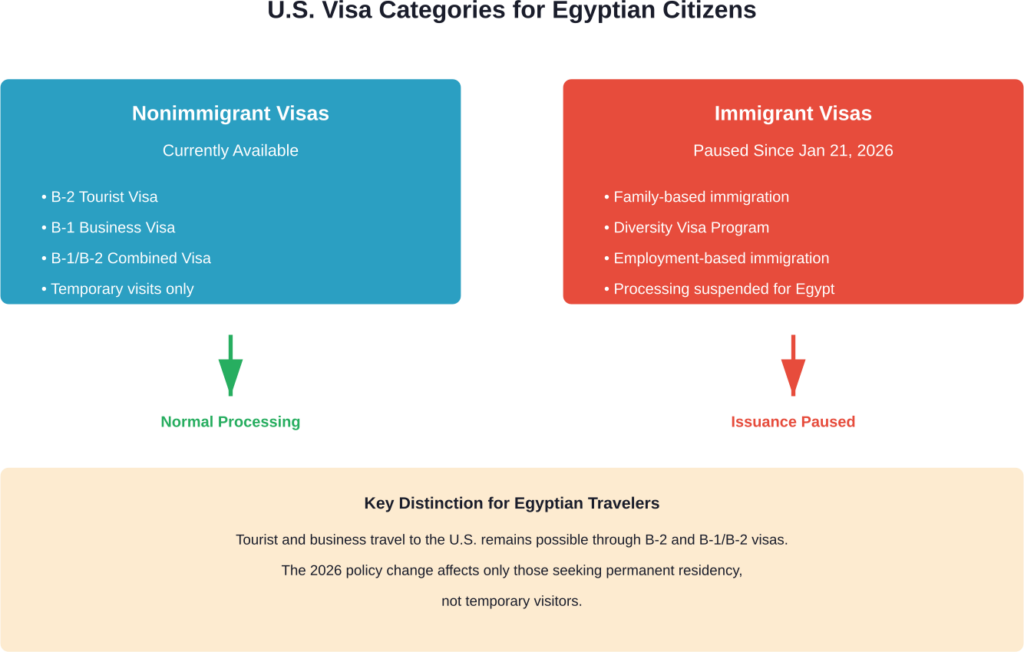
Here’s where things get complicated. Effective January 21, 2026, the Department of State paused all immigrant visa issuances to nationals of countries, including Egypt and Sudan, whose immigrants have a high rate of collecting public assistance at the expense of the U.S. taxpayer.
This policy specifically affects immigrant visas—those for permanent residence in the United States. According to the U.S. Embassy in Egypt, immigrant visa applicants who are nationals of impacted countries may submit visa applications and attend interviews, and the Department of State will continue to schedule consular appointments.
But what does this mean for tourists?
Impact on Tourist and Business Visas
The January 2026 policy change targets immigrant visas, not nonimmigrant tourist or business visas. Egyptian citizens can still apply for and receive B-2 tourist visas and B-1/B-2 visitor visas through the standard application process.
The U.S. Embassy in Cairo continues to provide nonimmigrant visa services for Egyptian citizens seeking temporary visits to the United States.
That said, all visa applications undergo scrutiny regardless of category. The broader policy environment may influence processing times and approval rates even for nonimmigrant applications.
The B-2 Tourist Visa Application Process
Applying for a U.S. tourist visa involves several steps. The process requires careful attention to detail and proper documentation.
Step 1: Complete the DS-160 Form
The DS-160 is the Online Nonimmigrant Visa Application form. Every applicant must complete this form electronically.
The form asks for personal information, travel plans, passport details, and background questions about criminal history, previous visa denials, and other security-related topics.
Applicants should answer all questions truthfully and completely. Providing false information can result in permanent visa ineligibility.
After submission, print the DS-160 confirmation page with the barcode. This document is required for the visa interview.
Step 2: Pay the Visa Application Fee
The nonimmigrant visa application fee is required before scheduling an interview. According to the U.S. Embassy in Egypt, payment can be made in cash or by credit card.
The fee is non-refundable, regardless of whether the visa is approved or denied.
Keep the payment receipt, as the receipt number is needed to schedule the visa interview appointment.
Step 3: Schedule the Visa Interview
Most applicants between the ages of 14 and 79 must attend an in-person interview at the U.S. Embassy in Cairo or a designated consular location.
The U.S. Embassy in Egypt provides visa services at the following address: 5 Tawfik Diab St, Qasr Ad Dobarah, Qasr El Nil, Cairo Governorate 11451, Egypt. The telephone number is +20-2-2797-3300.
Appointment wait times vary depending on demand. During peak travel seasons, appointments may be booked several weeks in advance.
Step 4: Gather Required Documents
Applicants must bring specific documents to the visa interview:
- Valid passport with at least six months validity beyond the intended stay
- DS-160 confirmation page
- Visa application fee payment receipt
- Passport-style photograph meeting U.S. visa photo requirements
- Appointment confirmation page
Additional supporting documents strengthen the application:
- Evidence of ties to Egypt (employment letter, property ownership, family connections)
- Bank statements showing financial ability to support the trip
- Detailed travel itinerary including flight reservations and hotel bookings
- Letter of invitation from U.S. contacts (if visiting friends or family)
- Previous U.S. visas or travel history to other countries
According to State Department guidance, at least one blank passport page is needed for the visa stamp.
Step 5: Attend the Visa Interview
The consular officer will ask questions about the purpose of travel, ties to Egypt, employment, family situation, and previous travel history.
Officers assess whether applicants have sufficient ties to Egypt to ensure they’ll return after their visit. Strong ties include stable employment, property ownership, family responsibilities, and ongoing education.
The interview typically lasts between 5 and 15 minutes. Officers make decisions based on the totality of information available, including the DS-160 form, supporting documents, and interview responses.
Step 6: Visa Processing and Passport Return
If approved, the embassy will retain the passport for visa processing. Processing times vary but typically take 3-5 business days.
The passport with the visa stamp is returned through a designated delivery service or can be picked up at the embassy.
If denied, the consular officer will provide a written explanation of the reason for denial. Some denials are overcome by providing additional documentation; others are permanent.
Common Reasons for Visa Denial
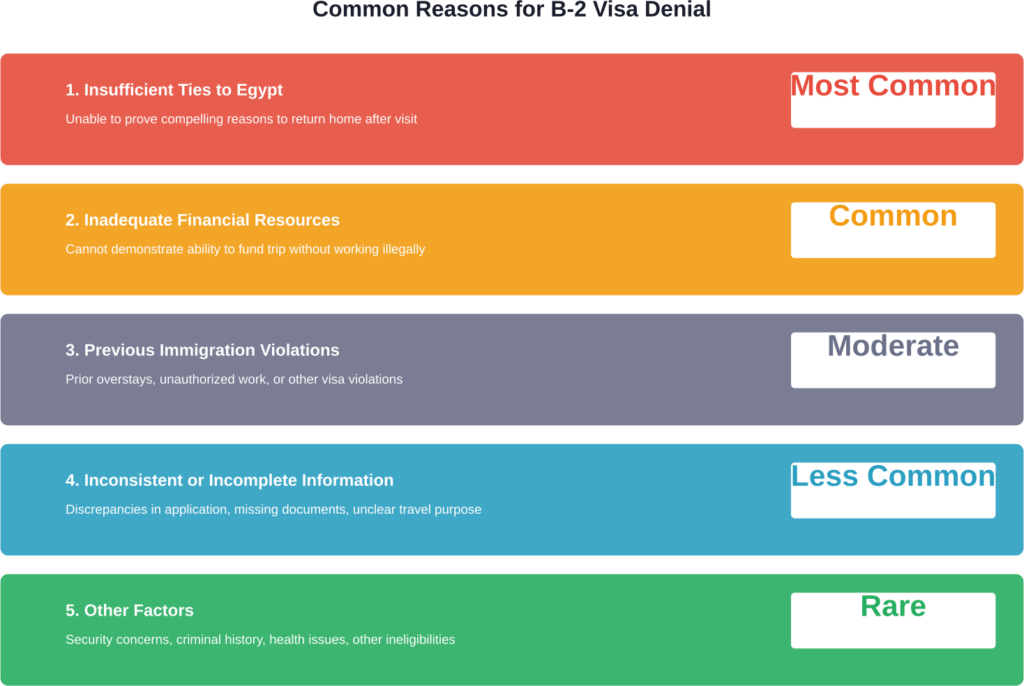
Understanding why visas get denied helps applicants prepare stronger applications. The most common reason is failure to demonstrate sufficient ties to Egypt.
Insufficient Ties to Home Country
Under U.S. immigration law, every nonimmigrant visa applicant is presumed to have immigrant intent—the intention to stay permanently in the United States. Applicants must overcome this presumption by demonstrating strong ties to Egypt.
Consular officers look for evidence that applicants have compelling reasons to return home: jobs, family, property, business interests, or other commitments.
Young, single applicants with limited employment history face higher scrutiny because they present fewer obvious ties.
Financial Insufficiency
Applicants must demonstrate they can financially support themselves during their U.S. visit without working illegally or becoming a public charge.
Bank statements, employment verification, and sponsor letters help establish financial capacity. The amount varies depending on trip length and planned activities.
Previous Immigration Violations
Overstaying a previous U.S. visa, working without authorization, or violating the terms of admission creates serious problems for future applications.
Immigration violations often result in multi-year bars to reentry. Even minor violations carry consequences.
Incomplete or Inconsistent Information
Discrepancies between the DS-160 form, supporting documents, and interview statements raise red flags. Consular officers compare all information sources.
Simple mistakes can usually be clarified, but significant inconsistencies suggest dishonesty.
Duration and Validity of B-2 Tourist Visas
Egyptian citizens often receive multiple-entry B-1/B-2 visas valid for several years. The validity period represents how long the visa can be used to enter the United States, not how long visitors can stay during each trip.
Common validity periods range from one to ten years, depending on reciprocity agreements and individual circumstances.
Length of Stay vs. Visa Validity
A ten-year visa doesn’t mean staying in the United States for ten years. It means the visa can be used for multiple entries over that ten-year period.
Each individual stay is determined by the Customs and Border Protection officer at the port of entry, who stamps the passport with an admission date and permitted duration.
For B-2 tourist visas, the typical initial admission period is six months, though officers may grant shorter periods based on stated travel plans.
Extending Your Stay
Visitors who need to extend their stay beyond the initial admission period can file for an extension before the authorized stay expires. This involves submitting Form I-539, Application to Extend/Change Nonimmigrant Status, to U.S. Citizenship and Immigration Services.
Extensions aren’t guaranteed and should be requested well before the current authorization expires. Overstaying even by one day creates future visa problems.
Costs Associated with U.S. Visa Applications
Applying for a U.S. visa involves several expenses beyond the basic application fee.
Mandatory Visa Application Fee
The nonimmigrant visa application fee is set by the U.S. Department of State and applies to B-2 tourist visa applications. Current fee information should be verified at the U.S. Embassy in Cairo website as fees are subject to change.
This fee is paid before scheduling the visa interview and is non-refundable regardless of the application outcome.
Additional Costs to Consider
Travel to Cairo for the embassy interview adds expenses for applicants living outside the capital. This includes transportation, and potentially overnight accommodation.
Passport photos must meet specific U.S. requirements. Professional photo services typically charge modest fees for compliant photos.
Document translation costs apply if supporting documents aren’t in English. Certified translations are sometimes required.
Courier fees for passport return are standard, unless applicants choose to pick up passports in person from the embassy.
Tips for a Successful Visa Application
Community discussions and user experiences highlight strategies that improve approval chances.
Demonstrate Strong Ties to Egypt
Employment stability matters. Long-term employment with established companies signals commitment to returning home. Bring employment verification letters on official company letterhead.
Property ownership provides tangible evidence of ties. Bring property deeds or rental agreements showing ongoing responsibilities.
Family connections help, particularly for married applicants with children in Egypt. Family registration documents and birth certificates support these claims.
Ongoing education commitments work well for students. University enrollment letters showing upcoming semesters create compelling return incentives.
Prepare Financially
Bank statements should cover at least six months and show consistent account activity. Large, sudden deposits immediately before application raise suspicion.
Sponsor letters work when the applicant’s finances are limited. U.S.-based sponsors can provide affidavits of support showing they’ll cover expenses. Sponsors should include their financial documents as well.
Be Honest and Consistent
Never lie on visa applications. Dishonesty results in permanent ineligibility, even if the underlying issue was minor.
Consistency across all documents matters. Review the DS-160 form before the interview to ensure interview answers align with written responses.
If circumstances have changed since completing the form, explain the changes proactively during the interview.
Prepare a Clear Travel Plan
Vague travel plans suggest uncertainty or hidden intentions. Specific itineraries with confirmed reservations demonstrate legitimate tourism purposes.
Flight reservations, hotel bookings, tour reservations, and event tickets all support the application. While confirmed bookings strengthen cases, hold refundable reservations until visa approval.
Practice Interview Responses
Common interview questions include:
- Why do you want to visit the United States?
- Who will you visit or what will you see?
- How long do you plan to stay?
- Who is paying for your trip?
- What is your job and how long have you worked there?
- Do you have family in the United States?
- Have you traveled to other countries before?
Practice concise, honest answers. Officers appreciate direct responses over long explanations.
Entry Requirements Beyond the Visa
Having a valid visa doesn’t guarantee entry to the United States. Customs and Border Protection officers at the port of entry make final admissibility determinations.
Valid Passport Requirements
Passports must remain valid for at least six months beyond the intended departure date from the United States. This is known as the six-month validity rule.
The passport must have at least one blank page for the admission stamp.
Currency Declarations
According to State Department guidance, travelers entering the United States with less than $10,000 in currency don’t need to declare it. Amounts of $10,000 or more require declaration using FinCEN Form 105.
The same applies when exiting Egypt—amounts less than $10,000 don’t require declaration.
Failure to declare amounts exceeding $10,000 can result in seizure of the funds and potential criminal charges.
Customs and Border Protection Inspection
All arriving passengers undergo CBP inspection. Officers verify travel documents, ask questions about the visit’s purpose, and may review luggage.
Officers assess whether visitors will comply with visa terms and have no intention of overstaying or working illegally.
Even with a valid ten-year visa, admission for each specific trip requires CBP approval.
Traveling to the U.S. with Family
Each family member requires their own visa, regardless of age. This includes infants and children.
Family Applications
Families can apply together and schedule interview appointments for the same time. This streamlines the process and allows consular officers to assess family ties collectively.
Each person still needs individual DS-160 forms, passport photos, and application fees.
Children and Minor Applicants
Children under 14 may be eligible for interview waivers under certain circumstances, though this varies based on individual situations and embassy policies.
Even when interview waivers are granted, all other application requirements remain, including forms, fees, and supporting documents.
Special Circumstances and Visa Categories
While B-2 tourist visas cover most leisure travel, other situations require different visa types.
Medical Treatment in the United States
Medical tourism falls under B-2 visa purposes. Applicants seeking medical treatment should bring:
- Medical diagnosis from Egyptian physicians
- Letters from U.S. medical facilities confirming treatment appointments
- Evidence of payment arrangements for medical expenses
- Proof of transportation and accommodation arrangements
Medical treatment cases often require demonstrating how treatment will be paid for, as U.S. medical care is expensive.
Visiting Family Members
Egyptian citizens with family in the United States should bring invitation letters from their relatives, including:
- Host’s full name and contact information
- Relationship to the applicant
- Host’s immigration status in the U.S. (citizen, permanent resident, visa holder)
- Detailed visit plans
If the host offers financial support, include their bank statements and a statement of financial support.
Business Travel
Business purposes require B-1 or B-1/B-2 visas. Business travelers should bring:
- Letter from Egyptian employer explaining the business purpose
- Invitation from U.S. business partners or conference organizers
- Evidence of business relationships between Egyptian and U.S. entities
The B-1 visa prohibits productive employment or receiving payment from U.S. sources. Business activities must be limited to meetings, negotiations, and consultations.
| Visa Type | Primary Purpose | Activities Allowed | Activities Prohibited |
|---|---|---|---|
| B-2 Tourist | Leisure travel | Tourism, visiting family, medical treatment, social events | Employment, study, permanent residence |
| B-1 Business | Business activities | Meetings, negotiations, conferences, consulting | Productive employment, receiving U.S. salary |
| B-1/B-2 Combined | Mixed purposes | All B-1 and B-2 activities | All B-1 and B-2 prohibitions |
Diversity Visa Program Considerations
The Diversity Visa Program offers another pathway to the United States, though it’s fundamentally different from tourist visas.
According to U.S. Citizenship and Immigration Services, no single country may receive more than 7 percent of the DVs available in any fiscal year. The State Department issued updates regarding Egypt approaching this cap for the Diversity Visa Program 2025.
The DV Program provides immigrant visas through a lottery system to nationals of countries with low immigration rates to the United States. Winners receive permanent residence, not temporary visitor status.
However, as noted earlier, the January 21, 2026 policy change paused immigrant visa issuances for Egyptian nationals, which includes Diversity Visa processing.
Egyptian nationals selected in the DV lottery may still submit applications and attend interviews, but actual visa issuance remains suspended pending policy changes.
Visa Reciprocity and Validity Periods
Visa validity and fees are based on reciprocity between countries. Reciprocity means the United States grants visa terms similar to those Egypt offers American citizens.
The State Department maintains reciprocity schedules showing visa validity periods and fees for each country. These schedules reflect bilateral agreements and can change based on diplomatic relationships.
For Egyptian citizens, multiple-entry B-1/B-2 visas are commonly issued with validity periods ranging from one to several years, though individual circumstances affect specific determinations.
Maintaining Legal Status During Your Visit
Once admitted to the United States, visitors must maintain their status by complying with visa terms.
Respecting the Authorized Stay Period
The Form I-94, Arrival/Departure Record, shows the authorized stay period. This is accessible online at cbp.gov/i94.
Departing the United States before or on the last day of authorized stay is mandatory. Overstaying creates serious consequences.
Consequences of Overstaying
Overstaying a U.S. visa, even by one day, results in automatic visa cancellation. The visa becomes void regardless of remaining validity.
Overstays of more than 180 days trigger three-year bars to reentry. Overstays exceeding one year trigger ten-year bars.
These bars prevent obtaining new visas and returning to the United States for the specified period, with limited exceptions.
Prohibited Activities
B-2 visa holders cannot:
- Work or receive payment for services
- Enroll in academic study programs (though short recreational courses may be allowed)
- Establish permanent residence
- Engage in activities inconsistent with tourism
Violating status terms results in deportation and future visa ineligibility.
Reapplying After Visa Denial
Visa denials aren’t necessarily permanent. In many cases, applicants can reapply after addressing the reasons for denial.
Understanding the Denial Reason
Consular officers provide written explanations for denials, typically citing specific sections of the Immigration and Nationality Act.
The most common citation is Section 214(b), which relates to failure to establish sufficient ties to the home country.
Understanding the specific reason helps determine whether reapplication makes sense and what additional evidence might help.
When to Reapply
Reapplying immediately after denial rarely succeeds unless circumstances have genuinely changed. If the situation remains the same, officers will likely reach the same conclusion.
Meaningful changes might include:
- Starting a new job with better stability
- Purchasing property
- Getting married or having children
- Accumulating additional financial resources
- Completing education programs
Time alone doesn’t overcome denials—changed circumstances do.
Additional Documentation for Reapplication
Reapplicants should bring new evidence addressing the previous denial reason. Simply resubmitting the same documents produces the same result.
A brief written statement explaining what has changed since the previous application can help focus the officer’s attention on new circumstances.
Alternative Options for Egyptian Citizens
While direct U.S. travel requires a visa, other options exist for Egyptian citizens interested in experiencing North America.
Canada and Mexico Tourist Visits
Visiting Canada or Mexico can be easier for Egyptian citizens, though these countries also have their own visa requirements.
Some travelers visit neighboring countries first, then apply for U.S. visas from there, though this doesn’t improve approval chances and adds complexity.
Transit Through the United States
Even transiting through U.S. airports to reach other destinations typically requires a visa. Unlike some countries that offer transit-without-visa programs, the United States requires proper documentation for most transit passengers.
The C-1 transit visa exists for this purpose, though many travelers simply use B-1/B-2 visas for transit as well.
Resources for Egyptian Visa Applicants
The U.S. Embassy in Egypt provides multiple resources to assist visa applicants.
Visa Navigator Tools
According to the U.S. Embassy in Egypt, visa navigator tools are available in both English and Arabic. These navigators ask a series of simple questions to direct applicants to online information on common topics or provide instructions on contacting the embassy for assistance.
The navigator helps determine which visa category is appropriate and guides applicants through the process step-by-step.
Embassy Contact Information
The U.S. Embassy in Cairo provides visa services at: 5 Tawfik Diab St, Qasr Ad Dobarah, Qasr El Nil, Cairo Governorate 11451, Egypt.
Telephone: +20-2-2797-3300
Fax: +20-2-2797-3200
The embassy also maintains updated information on its website addressing current processing times, appointment availability, and any temporary service changes.
Official Government Resources
The State Department’s travel.state.gov website provides comprehensive information about visa requirements, application procedures, and country-specific guidance.
The USTravelDocs website handles visa appointment scheduling and provides country-specific processing information.
Current Security and Travel Considerations
The State Department regularly issues travel advisories and security alerts affecting travelers worldwide.
Middle East Security Updates
Following recent events in the Middle East, the State Department has issued guidance for Americans in the region. While these primarily affect U.S. citizens abroad, they reflect the broader security environment that may influence visa processing and travel decisions.
Egyptian citizens should monitor both U.S. Embassy Cairo announcements and Egyptian government travel advisories when planning international travel.
Interview Appointment Availability
Security situations, staff availability, and demand fluctuations affect embassy operations. During periods of heightened security concerns, appointment availability may be limited or processing times extended.
Applicants should check current wait times before making non-refundable travel arrangements.
Understanding U.S. Immigration Intent
The concept of immigrant intent is central to nonimmigrant visa applications and often misunderstood.
The Presumption of Immigrant Intent
U.S. immigration law presumes every nonimmigrant visa applicant intends to immigrate permanently. This presumption must be overcome with evidence.
This doesn’t mean officers assume applicants are lying. It’s a legal standard requiring proof of temporary visit intentions.
Dual Intent vs. Nonimmigrant Intent
Some visa categories allow dual intent—simultaneous interest in temporary visits and future immigration. B-2 tourist visas do not allow dual intent.
Tourist visa applicants must demonstrate no current intention to immigrate, even if long-term immigration might be desirable eventually.
Mentioning interest in future immigration during a tourist visa interview typically results in denial.
Working with Immigration Attorneys
While not required for B-2 visa applications, immigration attorneys can help in complex situations.
When Legal Assistance Helps
Attorneys are most valuable when:
- Previous applications were denied for unclear reasons
- Criminal history or other complicated factors exist
- Family members have different nationalities or statuses
- Large financial transactions or business interests need explanation
- Previous immigration violations require waiver applications
Straightforward tourist visa applications typically don’t require attorney assistance. The process is designed for self-filing.
Choosing an Immigration Attorney
If legal help is needed, work with attorneys licensed to practice U.S. immigration law. Credentials and experience matter.
Be wary of unauthorized immigration consultants or notarios who aren’t licensed attorneys. Unqualified practitioners cannot provide legal representation and may harm cases.
| Application Factor | Strengthens Application | Weakens Application |
|---|---|---|
| Employment | Stable, long-term job; management position; specialized skills | Unemployed; recent job start; cash-based informal work |
| Financial Status | Consistent income; substantial savings; property ownership | Limited funds; irregular income; no assets |
| Family Ties | Spouse and children in Egypt; elderly parents requiring care | Close family members in U.S.; single with no dependents |
| Travel History | Previous travel to developed countries; consistent visa compliance | No previous travel; overstays in any country |
| Travel Purpose | Specific itinerary; confirmed bookings; clear purpose | Vague plans; no specific destinations; open-ended dates |
COVID-19 and Health Requirements
While pandemic-related restrictions have largely eased, health requirements for international travelers continue evolving.
Current Health Screening
Travelers should check current CDC requirements before departure. Requirements can change based on global health conditions.
Some vaccinations or health certifications may be required depending on current public health policies.
Travel Insurance Considerations
U.S. healthcare is expensive. International travel insurance covering medical emergencies during U.S. visits is strongly recommended, though not required for visa applications.
Some visa applicants bring evidence of travel insurance to demonstrate financial preparedness for emergencies.
Planning Your Trip After Visa Approval
Once the visa is approved, careful trip planning ensures smooth travel.
Booking Flights and Accommodations
Book only after visa approval unless reservations are fully refundable. Denied visa applications happen, and non-refundable bookings create financial losses.
Keep all booking confirmations accessible during travel, as CBP officers may request them at entry.
Preparing for Port of Entry
Carry documentation supporting the visit’s purpose:
- Return flight tickets
- Hotel reservations or host contact information
- Tour bookings or event tickets
- Employment verification letters
- Financial documents
While not always requested, having documents readily available facilitates entry processing.
Understanding Customs Regulations
Familiarize yourself with U.S. customs regulations regarding prohibited and restricted items. Agricultural products, certain foods, and counterfeit goods face restrictions.
Declare all items as required. Customs violations create serious problems for future travel.
Frequently Asked Questions
No, Egyptian citizens cannot visit the USA without a visa. Egypt is not part of the Visa Waiver Program, which means all Egyptian nationals must obtain proper visas before traveling to the United States, regardless of the visit’s purpose or duration. The most common visa for tourism is the B-2 or B-1/B-2 visitor visa.
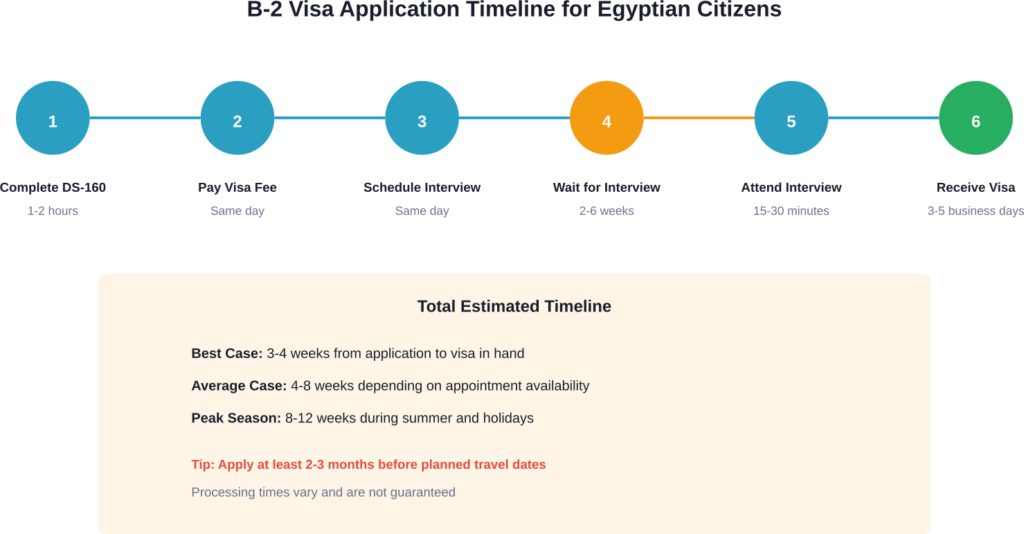
The timeline varies depending on appointment availability and processing times. Generally, applicants should expect 3-8 weeks from initial application to receiving the visa. During peak travel seasons or periods of high demand, wait times can extend to 8-12 weeks. Applicants should apply at least 2-3 months before planned travel dates to account for potential delays.
The nonimmigrant visa application fee is set by the U.S. Department of State and applies to B-2 tourist visa applications. Current fee information should be verified at the U.S. Embassy in Cairo website as fees are subject to change.
The visa’s validity period differs from the permitted stay duration. While B-2 visas are often valid for multiple years, each individual stay is determined by the Customs and Border Protection officer at the port of entry. Typical initial admission periods are up to six months, though officers may grant shorter periods based on stated travel plans. The actual permitted stay is stamped in the passport upon entry.
If denied, the consular officer provides a written explanation citing the specific reason. The most common reason is inability to demonstrate sufficient ties to Egypt under Section 214(b) of the Immigration and Nationality Act. Applicants can reapply once circumstances genuinely change, bringing new evidence addressing the denial reason. The visa fee must be paid again for each new application. There is no appeal process for visa denials.
No, B-2 tourist visa holders cannot work or receive payment for services in the United States. The B-2 visa is strictly for tourism, visiting family, medical treatment, and similar activities. Working without authorization violates visa terms and results in deportation and future visa ineligibility. Those seeking to work in the U.S. must obtain appropriate work visas through separate application processes.
It depends on the overall circumstances. Having family in the U.S. can support tourism applications if the visit is clearly temporary and strong ties to Egypt exist. However, close family members with U.S. status (especially parents, children, or siblings) may raise concerns about immigrant intent. The key is demonstrating compelling reasons to return to Egypt after the visit, regardless of family connections abroad. Honesty about family relationships is essential—lying about family in the U.S. results in permanent visa ineligibility.
Conclusion
Egyptian citizens planning to visit the United States face clear requirements: a valid visa is mandatory before travel. The B-2 tourist visa or B-1/B-2 combined visa provides the pathway for temporary visits.
The application process demands careful preparation. Strong ties to Egypt, sufficient financial resources, honest documentation, and clear travel purposes form the foundation of successful applications.
Recent policy changes have affected immigrant visa processing for Egyptian nationals, but tourist and business visas remain available through standard procedures at the U.S. Embassy in Cairo.
Starting the application process early—at least 2-3 months before planned travel—accounts for appointment wait times and processing delays. Proper documentation, honest interview responses, and demonstrated intent to return to Egypt maximize approval chances.
The United States welcomes international visitors for tourism, business, and cultural exchange. With proper preparation and understanding of requirements, Egyptian citizens can successfully obtain visas and experience travel to America.
Ready to start the visa application process? Visit the U.S. Embassy in Egypt’s website for the visa navigator tool, current appointment availability, and detailed application instructions. Begin the DS-160 form online at the State Department’s official portal, and take the first step toward your U.S. visit today.