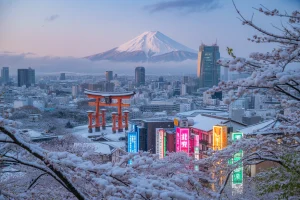
When Is the Best Season to Visit Japan? Japan is a country where every season feels magical. There’s truly no “bad” time to visit, but each period offers something different.
Spring (March-May) is the most popular time to travel. Millions of tourists visit Japan to witness the iconic cherry blossom season. The weather is mild, around +15-22°C, perfect for exploring Tokyo, Kyoto, and Nara’s famous parks.
Autumn (September-November) is the second peak season. The maple leaves turn golden and red, creating breathtaking scenery, with temperatures from +13 to +23°C. It’s a paradise for photographers and nature lovers.
Winter (December-February) is a quieter but equally beautiful time to visit. Snow blankets the central and northern regions, turning ski resorts into a winter wonderland. In southern Japan, the climate remains mild and sunny – ideal for sightseeing and relaxing in hot springs (onsen).
Summer (June-August) is the season of festivals, mountain hikes, and lush greenery, but be ready for high humidity and heat, especially in July and August.
Top Things to Do in Japan During Winter
Winter in Japan is more than just cold weather, it’s a season full of warmth, comfort, flavor, and unique beauty. Whether you love skiing or cozy cultural experiences, there’s something for everyone.
1. Go Skiing or Snowboarding
Japan is one of the world’s top ski destinations. The best resorts are located in Hokkaido (Niseko, Furano) and Nagano (Hakuba, Nozawa Onsen). The powder snow here is famously light and dry, creating perfect skiing conditions. Many resorts also have hotels with open-air hot springs at the base of the slopes – the ultimate après-ski relaxation.
2. Relax in a Traditional Onsen
After a chilly day outside, nothing beats soaking in a natural hot spring. Some of the most famous onsen towns are Hakone, Beppu, Kusatsu, and Noboribetsu. Many offer open-air baths with mountain or snow views – a truly authentic Japanese experience.
3. Visit Winter Festivals
Japan’s winter festivals are breathtaking. The most famous is the Sapporo Snow Festival in early February, where enormous ice and snow sculptures fill the streets. In Niigata, you can enjoy stunning light festivals, where trees and buildings are covered in millions of sparkling lights.
4. Try Japan’s Winter Cuisine
Winter is all about comfort food. Locals warm up with:
Nabe (hot pot) – meat, tofu, and vegetables simmered in broth at the table.
Oden – slow-cooked eggs, fish cakes, and daikon in soy broth.
Ramen – hearty noodles in rich soup, best enjoyed steaming hot.
In mountain regions, you can also taste fresh seafood and local winter vegetables.
5. Enjoy Tokyo and Kyoto Without the Crowds
Winter is Japan’s low tourist season, which means fewer crowds and more serenity. It’s the perfect time to stroll through Kyoto’s temples, Tokyo’s Asakusa district, or Shibuya’s neon streets. In December and January, both cities are illuminated with beautiful festive lights.
Why You Should Visit Japan in Winter
Winter might be Japan’s most underrated travel season. While most travelers prefer cherry blossoms or autumn foliage, the colder months reveal a calmer, cozier, and more authentic Japan.
1. Fewer Tourists & Better Prices
From mid-January to February, crowds drop significantly, making it easier and cheaper to explore. You’ll find lower airfares and hotel rates, often 15-30% less than in spring. The only busy time is around New Year’s (Dec 29-Jan 3) when locals travel domestically.
2. Unique Winter Landscapes
Snow-covered villages, steaming hot springs, and wild monkeys bathing in onsen – these sights only exist in winter. The most picturesque spots include Shirakawa-go, snowy Mount Fuji, and the Jigokudani Snow Monkey Park in Nagano.
3. A Season of Comfort and Tradition
Winter in Japan feels warm and festive – full of hot sake, roasted chestnuts, and sweet mochi desserts. The streets glow with soft lights, and cafes serve limited-edition seasonal treats. It’s a time when Japan feels extra welcoming.
4. Perfect Transportation System
Despite the snow, Japan’s transportation runs flawlessly. Trains are punctual, roads are cleared quickly, and domestic flights make it easy to travel between islands. You can comfortably go from Tokyo to Hokkaido or Okinawa in just a few hours.
5. A New Perspective on Classic Cities
Famous spots like Kyoto, Nara, and Nikko look completely different in winter – peaceful, misty, and covered in snow. It’s the best time to experience Japan slowly, away from crowds, and truly connect with its calm atmosphere.
How to Prepare for a Winter Trip to Japan
Traveling from the UAE to Japan is very convenient thanks to several direct flight options offered by major airlines.
- From Dubai (DXB), Emirates operates daily non-stop flights to both of Tokyo’s major airports: Narita (NRT) and Haneda (HND). The average flight time is around 9 hours and 30 minutes. Emirates also flies directly from Dubai to Osaka (Kansai International Airport, KIX), which takes approximately 9 hours and 40 minutes.
- From Abu Dhabi (AUH), Etihad Airways offers a direct flight to Tokyo Narita (NRT) with a travel time of about 9 hours and 45 minutes.
In addition, ANA (All Nippon Airways) Japan’s flagship carrier – operates a direct flight from Dubai to Tokyo Haneda (HND), also taking around 9 hours and 30 minutes.
During winter, the time difference between the UAE and Japan is +5 hours.
Nearby Countries to Combine with Japan
If you have extra time, you can expand your trip and visit one or two nearby destinations:
- South Korea (Seoul, ICN) only 2 hours from Tokyo; a great mix of tradition and modern life.
- Taiwan (Taipei, TPE) about 3 hours; warm weather, night markets, and street food.
- China (Shanghai, PVG / Beijing, PEK) – 3-4 hours; ideal for a short cultural or business visit.
- Hong Kong (HKG) – 4 hours; perfect for shopping and city exploration.
Useful Travel Tips
- Tourist Japan visa processing for UAE residents takes around 4 working days.
- Pack comfortable, warm clothing and shoes: Tokyo averages +5-10°C, while Hokkaido can drop to -10°C.
- Buy a Japan Rail Pass for unlimited Shinkansen (bullet train) rides.
- Get a local eSIM or pocket Wi-Fi to stay connected and use live translation tools.
Why Apply for Your Japan Visa with The Visa Services
A trip to Japan requires attention to detail – and our team ensures your visa process is fast, stress-free, and precise.
- Fast appointment scheduling: we often find submission slots within 3-4 days after your request.
- Expert handling of complex cases: we help even when other agencies refuse – previous visa refusals, families with multiple passports, or complex travel histories. We increase the approval chance by up to 45% compared to self-submission.
- Visas for household staff: we know how to correctly prepare documents for nannies, drivers, or private chefs traveling with you.
- AI-assisted document checks: your documents are verified by both a human expert and our proprietary AI system, which predicts approval chances, suggests profile improvements, and eliminates human errors.
- Save your time: on average, our clients save up to 30 hours – almost a full work week.
- Licensed and transparent: we hold an official government license, work under contract, and ensure complete confidentiality of your data.
Don’t postpone your dream trip – apply now, and our visa expert will contact you to prepare everything for your submission.
FAQ: Frequently Asked Questions About Winter Travel in Japan
Because we turn a complicated process into a smooth and predictable experience:
We book submission appointments within 3-4 days.
We handle complex cases, previous refusals, and families with multiple passports.
Our expertise increases the approval rate by up to 45% compared to submitting on your own.
We process visas for nannies, drivers, chefs, and other staff traveling with you.
Every application is checked twice: by an expert and by our AI system, which predicts approval chances and eliminates errors.
We save you up to 30 hours of time – nearly an entire work week.
We operate with an official government license and always work under a legal contract.
Yes, UAE citizens and residents need a tourist visa to enter Japan.
Processing usually takes around 4 working days, and The Visa Services can arrange an appointment as fast as 3-4 days after you contact us.
Thanks to short regional flights, it’s easy to add another destination:
South Korea (Seoul) – 2 hours from Tokyo
Taiwan (Taipei) – 3 hours
China (Shanghai / Beijing) – 3-4 hours
Hong Kong – 4 hours
Direct flights take around 9 hours 30 minutes.
Typical routes include:
Dubai (DXB) => Tokyo (NRT/HND) Emirates, ANA (~9h 30m)
Dubai (DXB) => Osaka (KIX) Emirates (~9h 40m)
Abu Dhabi (AUH) => Tokyo (NRT) Etihad (~9h 45m)
Time difference in winter: Japan is +5 hours ahead of the UAE.
Winter is actually the most affordable season to travel (except for New Year’s holidays). Prices for flights and hotels are typically 15-30% lower than in spring, and attractions are less crowded.
Winter cuisine in Japan is warm, comforting and full of flavor:
Nabe (hot pot) vegetables, tofu and meat simmered in broth.
Oden daikon, eggs, tofu and fish cakes in slow-cooked soy broth.
Ramen hearty noodles in rich, warming broth.
Yakitori grilled chicken skewers, often paired with hot sake.
Japan hosts several spectacular winter events:
Sapporo Snow Festival – huge snow and ice sculptures (early February).
Niigata Light Festival – magical winter illuminations.
Nozawa Fire Festival – one of Japan’s most dramatic traditional celebrations.
Tokyo Winter Illuminations – sparkling light displays across the city in December and January.
An onsen is a natural hot spring bath, often outdoors. Top onsen towns include:
Hakone (near Tokyo)
Beppu (Kyushu Island)
Kusatsu (Gunma Prefecture)
Noboribetsu (Hokkaido)
Tip: Before entering the onsen, wash thoroughly – it’s an important part of Japanese etiquette.
Japan is one of the world’s top skiing destinations. The most famous resorts include:
Niseko (Hokkaido) world-class powder snow and luxury hotels.
Hakuba (Nagano) Olympic-level slopes, great for all skill levels.
Nozawa Onsen (Nagano) skiing combined with historic hot spring baths.
Furano (Hokkaido) fewer crowds and beautiful landscapes.
It depends on what you want to experience:
For snow, skiing and winter scenery – go to Hokkaido or Nagano.
For mild weather, culture and sightseeing – visit Tokyo, Kyoto, Osaka, or Hiroshima.
Winter in Japan lasts from December to February. Early December is still mild in central regions (around +10°C), but by January northern areas like Hokkaido and Nagano are fully covered in snow and ski season is in full swing.
[sp_faq category=”618″]