Quick Summary: Yes, citizens of Kazakhstan need a visa to visit the United States. All Kazakhstani nationals must obtain an appropriate U.S. visa before traveling, whether for tourism, business, study, or other purposes. Kazakhstan is not part of the Visa Waiver Program, so there are no exceptions for short visits.
Planning a trip to the United States from Kazakhstan? The visa question is probably the first thing on your mind. And the answer is straightforward: yes, Kazakhstani citizens absolutely need a visa to enter the U.S.
Unlike citizens from countries participating in the Visa Waiver Program, Kazakhstanis can’t just show up at a U.S. airport with a passport and an electronic authorization. Every trip requires proper visa documentation, regardless of duration or purpose.
But here’s what really matters: understanding which visa type fits your travel plans, how the application process works, and what documents the U.S. Embassy in Kazakhstan requires. That’s what this guide covers.
Why Kazakhstani Citizens Need a U.S. Visa
The United States maintains specific entry requirements for foreign nationals based on bilateral agreements, security considerations, and reciprocal travel arrangements. Kazakhstan doesn’t have a visa waiver agreement with the U.S., which means standard visa protocols apply to all Kazakhstani passport holders.
According to the U.S. State Department, tourist visas are required for Kazakhstani citizens visiting the United States. This requirement applies regardless of how long visitors plan to stay—even a three-day business meeting requires proper visa authorization.
The visa requirement system works both ways. American citizens can travel to Kazakhstan for tourism and stay up to 30 days without a visa. But beyond that threshold, Americans need an entry visa for Kazakhstan. This reciprocal arrangement reflects the standard diplomatic relationship between the two countries.
Types of U.S. Visas Available to Kazakhstani Citizens
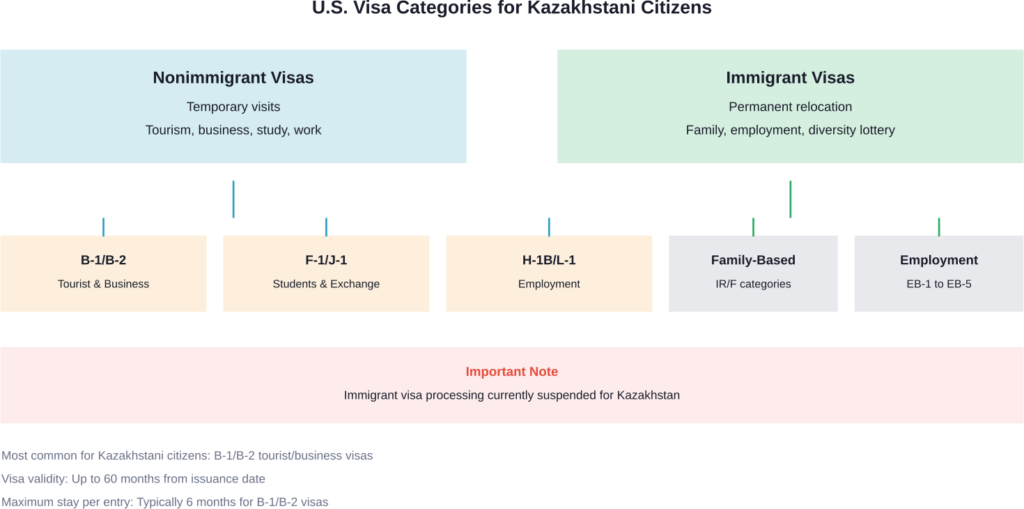
The U.S. visa system divides into two broad categories: nonimmigrant visas for temporary visits and immigrant visas for permanent relocation. The type needed depends entirely on travel purpose and intended duration.
Nonimmigrant Visas for Temporary Visits
Most Kazakhstani travelers need nonimmigrant visas. These temporary authorizations cover everything from tourism to student exchanges. According to information from the U.S. Embassy in Kazakhstan, common nonimmigrant visa classifications include:
| Visa Type | Purpose | Typical Duration |
|---|---|---|
| B-1 | Business visitors, conferences, consultations | Up to 6 months per entry |
| B-2 | Tourism, vacation, medical treatment | Up to 6 months per entry |
| F-1 | Academic students at accredited institutions | Duration of study program |
| J-1 | Exchange visitors, research scholars, interns | Program-specific |
| H-1B | Specialty occupation workers | Up to 3 years, renewable |
| L-1 | Intracompany transferees | Up to 7 years depending on category |
The B-1/B-2 tourist and business visa combination represents the most common choice for Kazakhstani visitors. This dual-purpose visa covers both business activities and leisure travel, offering flexibility for trips that might combine purposes.
According to U.S. State Department guidelines, visa validity periods can extend up to 60 months from the date of issuance. If the validity period is 60 months, the visa remains valid for that entire timeframe—though each individual stay still faces maximum duration limits.
Immigrant Visas for Permanent Relocation
Kazakhstani citizens seeking to move permanently to the United States need immigrant visas. These include family-sponsored visas, employment-based categories, and diversity visa lottery selections.
However, processing for immigrant visas from Kazakhstan has faced significant challenges. In January 2025, the U.S. State Department announced suspension of immigrant visa processing for 75 countries, including Kazakhstan. This measure reportedly targets countries whose citizens allegedly have high rates of reliance on public assistance after immigrating to the United States.
This suspension creates substantial delays for Kazakhstani nationals with approved immigrant visa petitions. While the policy continues to evolve, prospective immigrants should consult the U.S. Embassy in Kazakhstan for current processing timelines.
The U.S. Visa Application Process for Kazakhstani Citizens
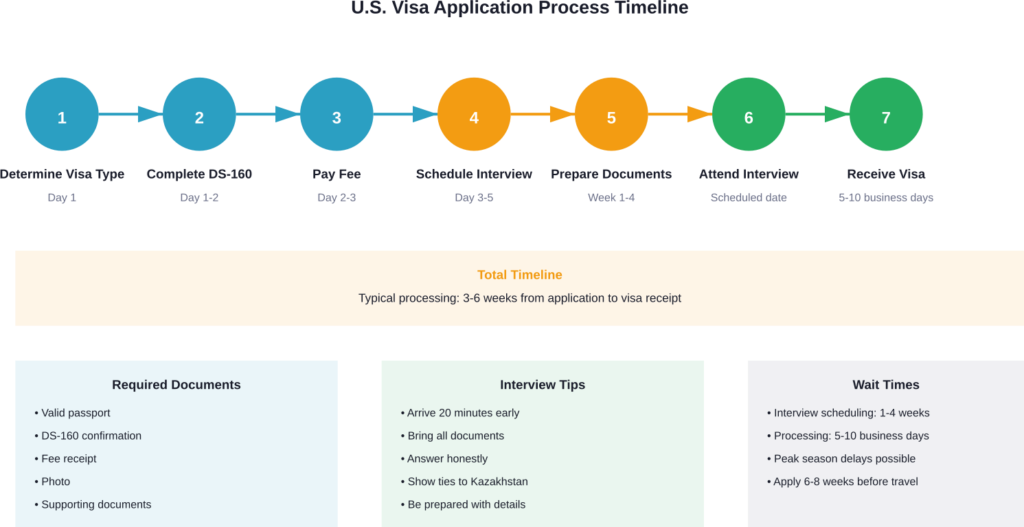
Applying for a U.S. visa from Kazakhstan involves several distinct steps. The process requires careful attention to documentation, fees, and interview preparation.
Step 1: Determine the Correct Visa Type
Before starting an application, identify the specific visa category that matches travel purposes. The wrong visa type leads to automatic denial, wasted fees, and delayed travel plans.
Tourism and family visits? That’s B-2. Business meetings, conferences, or contract negotiations? B-1 covers those activities. Planning to study at an American university? F-1 is the student visa category.
Step 2: Complete the DS-160 Form
All nonimmigrant visa applicants must submit Form DS-160, the Online Nonimmigrant Visa Application. This comprehensive form collects biographical information, travel history, employment details, and security-related questions.
The form requires careful completion—errors or inconsistencies can delay processing or trigger additional scrutiny. After submission, the system generates a confirmation page with a barcode. Keep this confirmation page; it’s required for the visa interview.
Step 3: Pay the Visa Application Fee
Visa application fees vary by category but are non-refundable regardless of the application outcome. Payment methods and amounts are specified on the U.S. Embassy’s visa information website.
After payment, retain the receipt. This proof of payment is necessary for scheduling the visa interview appointment.
Step 4: Schedule the Visa Interview
Most applicants between ages 14 and 79 must attend an in-person interview at the U.S. Embassy in Astana or the U.S. Consulate General in Almaty. According to embassy guidelines, applicants should arrive 20 minutes before their scheduled appointment time.
The appointment letter and passport must be shown to security personnel upon arrival. Applicants may bring one interpreter if they don’t speak English, Kazakh, or Russian.
Step 5: Prepare Required Documents
Documentation requirements vary by visa type, but standard documents include:
- Valid passport with at least one blank page for the visa stamp
- DS-160 confirmation page with barcode
- Visa application fee payment receipt
- Passport-sized photograph meeting U.S. visa photo specifications
- Interview appointment confirmation letter
Additional supporting documents strengthen the application. For B-1/B-2 visas, these might include proof of employment in Kazakhstan, evidence of financial resources, detailed travel itineraries, and documentation showing strong ties to Kazakhstan (property ownership, family relationships, business interests).
Bank statements and employment verification letters are commonly recommended to strengthen B-1/B-2 visa applications, as they demonstrate financial capacity and ties to Kazakhstan.
Step 6: Attend the Visa Interview
The consular officer interview represents the most critical component of the visa process. Officers assess whether applicants meet visa requirements and whether they intend to return to Kazakhstan after their U.S. visit.
Questions typically cover travel purposes, employment status, family ties in both countries, previous international travel, and plans while in the United States. Honest, consistent answers matter more than perfect English.
The officer makes a decision during or shortly after the interview. Approved applicants receive instructions for passport return with the visa stamp. Denied applications receive a written explanation of the grounds for refusal.
Common Reasons for U.S. Visa Denial
Not every application succeeds. Understanding common denial reasons helps Kazakhstani applicants strengthen their cases and avoid preventable mistakes.
Insufficient ties to Kazakhstan represents the primary denial reason for B-1/B-2 visas. Consular officers must be convinced applicants will return home after their U.S. visit. Strong ties include stable employment, property ownership, family obligations, and ongoing business or educational commitments in Kazakhstan.
Inadequate financial documentation also triggers denials. Applicants must demonstrate they can financially support themselves during the U.S. visit without working illegally or relying on public assistance.
Inconsistent information between the DS-160 form, interview responses, and supporting documents raises red flags. Even minor discrepancies can result in denial based on credibility concerns.
Previous immigration violations—overstaying a visa, working without authorization, or providing false information—create serious obstacles for future applications. Past violations don’t automatically disqualify applicants, but they require substantial evidence of changed circumstances.
Visa Validity and Duration of Stay
Here’s something applicants often confuse: visa validity and duration of stay are completely different things.
Visa validity indicates how long the visa itself remains active for entering the United States. According to U.S. State Department information, visa validity periods can extend up to 60 months from the issuance date. A visa valid for 60 months means the holder can use it to enter the U.S. anytime during those five years.
Duration of stay determines how long someone can remain in the U.S. during each visit. For B-1/B-2 visas, the typical maximum stay is six months per entry. The customs officer at the port of entry makes the final determination about duration of stay, stamping this information in the passport.
So a Kazakhstani citizen might hold a five-year tourist visa but still face a six-month maximum for each individual trip. The visa allows multiple entries during its validity period, but each stay has its own time limit.
Special Considerations for Kazakhstani Applicants
Several factors create unique circumstances for visa applicants from Kazakhstan.
Language Assistance
According to U.S. Consulate guidelines for Almaty, applicants may bring one interpreter to their visa interview if they don’t speak English, Kazakh, or Russian. This accommodation recognizes Kazakhstan’s multilingual population and ensures applicants can communicate effectively during the critical interview process.
Dual Citizenship Issues
Some individuals hold both Kazakhstani citizenship and citizenship in another country. For U.S. visa purposes, applicants should apply using the passport they plan to use for U.S. travel. If holding both a Kazakhstani passport and citizenship from a Visa Waiver Program country, using the VWP passport typically offers simpler entry procedures—though this depends on individual circumstances.
Regional Processing Centers
Kazakhstan has visa processing capabilities at both the U.S. Embassy in Astana and the U.S. Consulate General in Almaty. Applicants can generally choose which location works better based on their residence, though specific appointment availability varies.
Frequently Asked Questions
The complete process typically takes 3-6 weeks from initial application to receiving the passport with the visa stamp. Interview appointment wait times vary by season—summer months often see longer delays due to increased demand. Processing after a successful interview usually requires 5-10 business days for passport return. Applicants should begin the process at least 6-8 weeks before planned travel dates to account for potential delays.
The DS-160 application form is completed online, and appointment scheduling happens through the embassy’s online system. However, most applicants must attend an in-person interview at the U.S. Embassy in Astana or the Consulate General in Almaty. The process combines online elements with mandatory in-person components. There’s no fully remote application option for Kazakhstani citizens.
Denied applicants receive a written explanation citing the grounds for refusal. The visa application fee is non-refundable regardless of the decision. Applicants can reapply at any time by submitting a new application and paying another fee. However, the new application should address the reasons for the previous denial with additional documentation or changed circumstances. Simply reapplying without addressing the denial reasons rarely results in approval.
Yes, every traveler regardless of age needs their own visa. Children must have their own passports and their own visa applications. Parents or guardians complete the DS-160 form on behalf of minor children. During the interview, children under 14 typically don’t need to appear in person if both parents are present, though this can vary based on specific circumstances. Children 14 and older generally must attend the interview.
No. B-1/B-2 tourist and business visitor visas explicitly prohibit employment in the United States. Visa holders caught working without proper authorization face deportation, visa cancellation, and bars on future U.S. entry. For employment in the U.S., Kazakhstani citizens need proper work authorization such as H-1B, L-1, or other employment-based visa categories. These require employer sponsorship and separate application processes.
Visa fees vary by category and are subject to change. For current fee information, applicants should consult the U.S. Embassy in Kazakhstan’s official visa information website. Fees are non-refundable and must be paid before scheduling the interview appointment. Additional costs may include passport photos, document translation services, and travel to the embassy or consulate for the interview.
Extension requests are possible but not guaranteed. Applicants must file Form I-539, Application to Extend/Change Nonimmigrant Status, with U.S. Citizenship and Immigration Services before the authorized stay expires. Extensions require valid reasons such as medical emergencies, unexpected circumstances, or compelling humanitarian reasons. Overstaying without approval creates serious immigration violations that affect future visa applications and U.S. entry eligibility.
Alternatives and Related Travel Authorization
While standard visas represent the primary authorization method, some Kazakhstani citizens might qualify for alternative programs in specific circumstances.
The H-2A and H-2B temporary worker programs allow employers to bring foreign nationals for seasonal agricultural and non-agricultural work. U.S. Citizenship and Immigration Services maintains lists of eligible countries for H-2A and H-2B temporary worker programs. Check current USCIS announcements for the most up-to-date list of participating countries and Kazakhstan’s current eligibility status.
Transit visas (C-1) allow travelers to pass through the United States while traveling to another destination. These apply when making connecting flights through U.S. airports without leaving the international transit area—though many connections still require standard visitor visas.
Student and exchange visitor programs (F-1, J-1) require acceptance from U.S. institutions before visa application. These visas have distinct requirements including proof of admission, financial documentation showing ability to pay tuition, and ties to Kazakhstan ensuring return after study completion.
Preparing for Success: Final Tips
Strong applications share common characteristics. Documentation quality matters as much as quantity. Better to provide a few highly relevant documents than dozens of marginally useful papers.
Consistency is critical. Information provided on the DS-160, stated during the interview, and reflected in supporting documents must align perfectly. Contradictions create doubt about credibility.
Demonstrate clear intent to return. Evidence of ongoing obligations in Kazakhstan—employment contracts extending beyond the trip, property ownership, family responsibilities—strengthens applications significantly.
Start early. Last-minute applications create unnecessary stress and limit options if complications arise. Beginning the process 6-8 weeks before intended travel provides buffer time for unexpected delays.
Be honest. Attempting to hide information, exaggerate circumstances, or provide false documentation leads to denials and potentially permanent bars on U.S. entry. Honesty might not guarantee approval, but dishonesty almost certainly guarantees refusal.
Conclusion
So, do Kazakhstani citizens need a visa to visit the USA? Absolutely. Every trip requires proper visa authorization, whether for tourism, business, study, or other purposes.
The process demands careful preparation, thorough documentation, and patient navigation through multiple steps. But thousands of Kazakhstani citizens successfully obtain U.S. visas every year by understanding requirements, preparing strong applications, and demonstrating legitimate travel purposes.
Start by identifying the correct visa type for your travel plans. Complete the DS-160 carefully, gather supporting documentation that proves ties to Kazakhstan, and prepare for the interview by reviewing all submitted information.
The U.S. Embassy in Kazakhstan provides official guidance and updates on visa processing. For the most current information on fees, wait times, and requirements, visit the embassy’s official visa information service website.
Ready to begin your U.S. visa application? Start the DS-160 form today and take the first step toward your American journey.