




Quick Summary: Yes, Jordanian citizens need a visa to visit the United States for tourism, business, or any other purpose. Jordan is not part of the U.S. Visa Waiver Program, meaning all Jordanian passport holders must obtain the appropriate nonimmigrant visa before traveling to the U.S. However, Jordanians are eligible for the Global Entry trusted traveler program to expedite entry once they have their visa.
Planning a trip to the United States from Jordan? The visa question is probably at the top of your list. Unlike citizens from certain European and Asian countries who can simply fill out an online form and fly in, Jordanians face different requirements.
The United States maintains specific visa policies for every country, and understanding where Jordan stands in this system matters if you’re planning travel for vacation, business meetings, or visiting family. Let’s break down exactly what Jordanian passport holders need to know before booking that flight.
The Short Answer: Yes, Jordanians Need a U.S. Visa
Here’s the thing though—every Jordanian citizen must obtain a visa before traveling to the United States, regardless of the purpose or duration of their visit. There’s no exception to this rule.
Jordan is not among the 42 countries currently participating in the Visa Waiver Program (VWP). According to the Department of Homeland Security, the VWP permits citizens of 42 designated countries to travel to the United States for business or tourism for stays of up to 90 days without a visa. But that list doesn’t include Jordan.
This means Jordanian travelers cannot use ESTA (Electronic System for Travel Authorization). Instead, they must go through the full visa application process at the U.S. Embassy in Amman.
Understanding U.S. Visa Types for Jordanian Citizens
Not all visas serve the same purpose. The United States offers various visa classifications depending on why someone wants to enter the country.
B-1/B-2 Tourist and Business Visas
Most Jordanian travelers apply for B-1 or B-2 visas. The B-1 visa covers business activities like attending conferences, negotiating contracts, or consulting with business associates. The B-2 visa applies to tourism, vacation, visiting friends or family, and medical treatment.
Often, these two visa types get combined into a single B-1/B-2 visa, giving travelers flexibility for both business and tourist activities during their stay.
Other Common Visa Categories
Beyond tourist visas, Jordanians might need different visa types depending on their situation:
- F-1 visas for students attending U.S. universities or colleges
- J-1 visas for exchange visitors, including researchers and professors
- H-1B visas for specialty occupation workers
- L-1 visas for intracompany transferees
- E-2 visas for treaty investors and traders
Each visa category has distinct requirements, application procedures, and documentation needs.
The U.S. Visa Application Process from Jordan
Getting a U.S. visa from Jordan involves several steps. The process isn’t particularly complicated, but it does require careful attention to detail and proper documentation.
Step 1: Complete the DS-160 Form
The DS-160 is the online nonimmigrant visa application form. This comprehensive form collects biographical information, travel plans, employment history, and security-related questions.
Fill it out completely and accurately. Any inconsistencies or false information can result in visa denial. Save the confirmation page with the barcode—it’s essential for the interview.
Step 2: Pay the Visa Application Fee
Visa application fees vary depending on the visa type. For most nonimmigrant visas, applicants must pay the required fee before scheduling an interview appointment. Payment instructions are available through the U.S. Embassy website.
Keep the payment receipt. It’s needed for scheduling the interview.
Step 3: Schedule the Visa Interview
Most visa applicants between ages 14 and 79 must attend an in-person interview at the U.S. Embassy in Amman. Schedule the interview through the embassy’s appointment system.
But wait. Interview appointment availability can vary significantly depending on the season. During peak travel periods, wait times for interview slots may extend for several weeks. Apply early.
Step 4: Gather Required Documents
Before the interview, collect all necessary documentation. Required documents typically include:
- Valid Jordanian passport (must be valid for at least six months beyond intended stay)
- DS-160 confirmation page with barcode
- Visa application fee payment receipt
- Interview appointment confirmation
- Recent passport-style photograph (specific requirements apply)
- Supporting documents relevant to visa type
For B-1/B-2 visas, additional supporting documents might include proof of employment, bank statements, property ownership documents, or evidence of ties to Jordan.
Step 5: Attend the Visa Interview
Arrive at the U.S. Embassy in Amman on time for the scheduled interview. Security screening occurs before entry, so arrive early. Electronic devices, bags, and certain personal items aren’t permitted inside.
During the interview, a consular officer will ask questions about travel plans, employment, family ties, and reasons for visiting the United States. Answer honestly and confidently. The officer determines visa approval or denial based on this interview and submitted documentation.
Step 6: Wait for Processing
After the interview, visa processing times vary. Some visas get approved immediately, while others require additional administrative processing. The embassy will provide information about expected processing times.
Step 7: Receive the Passport with Visa
Once approved, the passport with the visa stamp can be collected according to the embassy’s procedures. Check the visa carefully for accuracy before leaving the pickup location.
Visa Validity Period for Jordanians
Here’s something interesting about U.S. visas—the validity period determines how long the visa remains valid for entry into the United States, not how long someone can stay.
According to State Department reciprocity schedules, visa validity periods can range significantly. Some visas remain valid for 60 months (five years) from the date of issuance. This means Jordanian citizens with a five-year B-1/B-2 visa can make multiple trips to the United States during that period without reapplying.
That said, the visa validity period differs from the permitted duration of stay. Upon entry, U.S. Customs and Border Protection officers determine how long visitors can remain in the country. For B-1/B-2 visas, the typical authorized stay is six months, though officers may grant shorter periods.
Required Documents for Jordanian Visa Applicants
Documentation requirements can make or break a visa application. Insufficient or questionable documentation frequently leads to visa denials.
| Document Category | Examples | Purpose |
|---|---|---|
| Identity Documents | Passport, national ID card, birth certificate | Verify identity and citizenship |
| Financial Evidence | Bank statements, employment letter, tax returns | Demonstrate financial ability to support trip |
| Ties to Jordan | Property deeds, business registration, family documents | Show intention to return to Jordan |
| Travel Plans | Flight itinerary, hotel reservations, invitation letters | Clarify purpose and duration of visit |
| Previous Travel | Old passports with stamps, previous visas | Establish travel history and compliance |
The consular officer needs confidence that applicants will return to Jordan after their visit. Evidence of strong ties to Jordan—like stable employment, property ownership, family connections, or ongoing education—strengthens applications.
Common Reasons for Visa Denial
Not every application gets approved. Understanding common denial reasons helps applicants avoid mistakes.
The most frequent denial reason involves insufficient demonstration of ties to Jordan. Immigration law presumes that every visa applicant intends to immigrate permanently. Applicants must overcome this presumption by showing strong connections to their home country.
Other common denial reasons include:
- Incomplete or inaccurate DS-160 forms
- Insufficient financial resources to support the trip
- Providing false or misleading information
- Previous immigration violations or overstays
- Security concerns or criminal history
- Unclear or suspicious travel purpose
Visa denials aren’t always permanent. Applicants can reapply, addressing the reasons for the previous denial with additional documentation or clarification.
Current Security Situation and Visa Services
Real talk: the Middle East security situation can impact visa services. According to recent notices from the U.S. Embassy in Jordan, visa appointments have occasionally been canceled due to security situations.
As of March 6, 2026, the U.S. Embassy in Jordan issued notices stating that all immigrant and nonimmigrant visa appointments were canceled until further notice due to current security situations. The embassy commits to rescheduling appointments once services resume.
Applicants with scheduled appointments should monitor the embassy website and email for updates. The safety of applicants remains the embassy’s priority during security situations.
Global Entry Program: Fast Track for Jordanians
Now, this is where it gets interesting. While Jordanians need visas to enter the United States, they qualify for something many countries don’t—Global Entry membership.
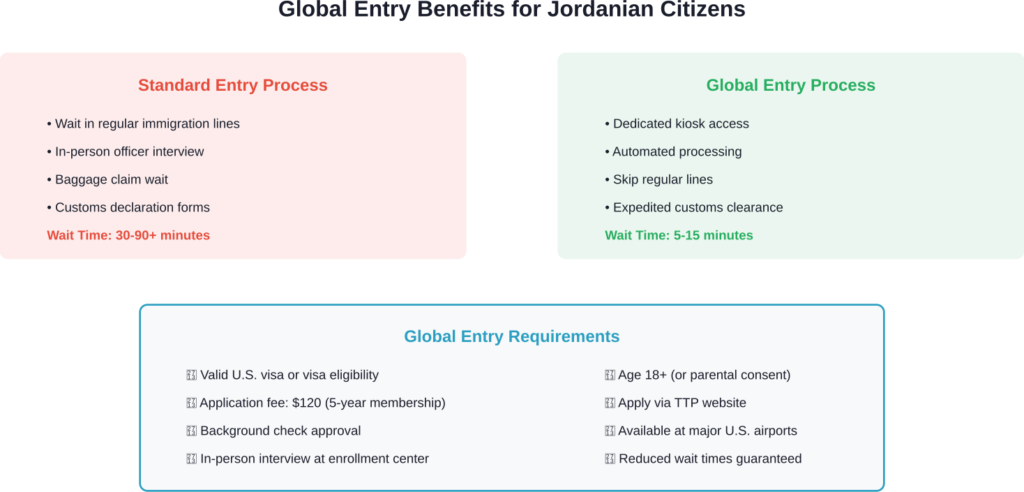
Global Entry is a U.S. Customs and Border Protection Trusted Traveler Program that allows expedited clearance for pre-approved, low-risk travelers upon arrival in the United States. According to CBP, citizens of the Hashemite Kingdom of Jordan can apply for Global Entry.
How Global Entry Works
The application fee is $120, and membership lasts for five years. Minors can be enrolled at no additional fee when a parent or legal guardian is already in or applying for Global Entry. All applicants must undergo a background check and be 18 years of age or older.
Jordanian citizens can apply through CBP’s Trusted Traveler Program website. The process includes:
- Submitting an online application
- Paying the non-refundable application processing fee
- Undergoing background vetting
- Scheduling an in-person interview at an enrollment center
- Receiving conditional approval or denial
Global Entry members use automated kiosks at major U.S. airports upon arrival, significantly reducing wait times. According to DHS, the United States welcomed approximately 18 million VWP travelers in FY 2023 who spent approximately $84 billion on goods and services, and trusted traveler programs help manage this volume while enhancing security.
Understanding Jordan’s Position in U.S. Immigration Policy
Jordan maintains a complex relationship with U.S. immigration policy. While not eligible for visa-free travel, Jordanian citizens benefit from certain programs like Global Entry that aren’t available to all nationalities.
The Visa Waiver Program currently includes 42 countries, but participation requires meeting strict criteria. Countries must have low visa refusal rates (typically under 3%), issue secure electronic passports, share security information with the United States, and meet various law enforcement cooperation requirements.
Jordan doesn’t currently meet all VWP criteria, particularly the low visa refusal rate threshold. This doesn’t reflect negatively on Jordan or Jordanian travelers—it’s simply a statistical threshold based on historical visa application patterns.
Visa Processing Times and Planning Your Trip
Timing matters tremendously when applying for U.S. visas. Processing times vary based on several factors including visa type, time of year, security clearance requirements, and embassy workload.
Generally speaking, applicants should start the visa process at least two to three months before intended travel dates. During peak travel seasons—summer months, holiday periods, or major U.S. events—appointment availability and processing times may extend considerably.
Some applications require additional administrative processing, which can take several weeks or longer. This typically happens when additional security checks or documentation reviews are necessary. Consular officers notify applicants if additional processing is required.
Medical Examinations for U.S. Immigrant Visas
While tourist visas don’t require medical examinations, Jordanians applying for immigrant visas must complete medical evaluations. According to embassy fee schedules, medical examinations for adults cost 135 JD per person (not including vaccines), while child examinations cost 55 JD per person.
These examinations must be conducted by embassy-approved physicians. Vaccines cost an additional amount—typically the hospital cost plus 25% as preset by Jordanian government regulations for the hospital’s percentage.
Tips for a Successful Visa Application
Sound familiar? Many applicants make preventable mistakes that lead to delays or denials. Following these guidelines improves approval chances.
Be Honest and Consistent
Honesty is absolutely crucial. Any false statements or document fraud will result in visa denial and potential permanent ineligibility. Consistency between the DS-160 form, interview answers, and supporting documents is essential.
Demonstrate Strong Ties to Jordan
The key to visa approval involves convincing the consular officer that there’s compelling reason to return to Jordan after the visit. Strong ties include:
- Stable, ongoing employment with return obligations
- Property ownership in Jordan
- Family members remaining in Jordan
- Ongoing educational enrollment
- Business ownership or partnerships
Prepare Financial Documentation
Demonstrate ability to financially support the trip without working in the United States. Bank statements, employment verification letters, and proof of income help establish financial stability.
Have Clear Travel Plans
Vague or suspicious travel plans raise red flags. Having specific travel dates, destinations, accommodations, and activities demonstrates serious intent and proper planning.
Prepare for the Interview
Practice answering common interview questions. Be ready to clearly explain:
- Purpose of the trip
- Planned activities and destinations
- Duration of stay
- Financial arrangements
- Ties to Jordan
- Previous international travel
What Happens If Your Visa Application Is Denied?
Visa denials happen, and they’re not necessarily the end of the road. Understanding why the application was denied is the first step toward addressing the issue.
Consular officers provide a written explanation of denial reasons, typically citing specific sections of U.S. immigration law. The most common denial falls under Section 214(b), which relates to insufficient demonstration of nonimmigrant intent.
Reapplying After Denial
There’s no mandatory waiting period before reapplying. However, simply resubmitting the same application with identical documentation will likely result in another denial.
Successful reapplications address the specific reasons for denial with additional evidence. This might include:
- Stronger documentation of ties to Jordan
- Additional financial evidence
- Clarification of travel purpose
- Letters from employers or family members
- Evidence of changed circumstances
Administrative Processing vs. Denial
Administrative processing differs from denial. Some applications require additional review before a decision can be made. This might involve security checks, document verification, or consultation with other agencies.
Administrative processing can take weeks or months. Applicants under administrative processing should remain patient and responsive to any embassy requests for additional information.
Special Circumstances and Exceptions
Certain situations involve special considerations or alternative processes for Jordanian citizens seeking to visit the United States.
Transit Visas
Jordanian citizens transiting through the United States to another country typically need either a C-1 transit visa or a valid B-1/B-2 visa. Even brief layovers at U.S. airports require proper visa documentation.
Previous U.S. Visa Holders
Having previously held a U.S. visa can simplify future applications, especially if there’s a history of compliance with visa terms. Previous travel to the United States without overstaying or violating visa conditions demonstrates trustworthiness.
Green Card Holders
According to available information, Jordanian permanent residents of the United States (Green Card holders) don’t need visas to return to the United States after temporary travel abroad. However, they must maintain their permanent resident status and not remain outside the U.S. for extended periods.
Comparing U.S. Visa Requirements for Jordanians vs. Other Nationalities
How do Jordanian visa requirements compare to other countries in the region and globally?
| Country/Region | U.S. Visa Requirement | Special Programs |
|---|---|---|
| Jordan | Visa required for all purposes | Global Entry eligible |
| European Union (most countries) | Visa Waiver Program eligible (ESTA only) | Global Entry for select countries |
| Gulf Cooperation Council countries | Varies by country; most require visas | Some Global Entry eligible |
| Egypt | Visa required for all purposes | Not Global Entry eligible |
| Israel | Visa Waiver Program eligible | Various trusted traveler programs |
Jordan’s eligibility for Global Entry puts it in a select group of countries whose citizens can access expedited entry programs despite requiring visas.
Resources for Jordanian Visa Applicants
Several official resources provide information and assistance for Jordanian citizens applying for U.S. visas.
U.S. Embassy in Amman
The U.S. Embassy in Amman handles all visa applications from Jordan. Their website provides current information about:
- Appointment scheduling
- Required documentation
- Processing times
- Fee payment methods
- Security updates affecting visa services
Online Visa Wizard Tools
The U.S. Embassy offers a visa wizard tool that helps applicants determine which visa type they need based on their specific situation and travel purpose.
State Department Resources
The U.S. Department of State’s travel website provides comprehensive information about visa policies, requirements, and procedures. This resource covers visa classifications, application processes, and country-specific information.
The Future of U.S. Visa Policy for Jordan
Immigration policies evolve based on diplomatic relationships, security considerations, and bilateral agreements. While there’s no current indication that Jordan will join the Visa Waiver Program in the near future, policy changes remain possible.
The expansion of programs like Global Entry to Jordanian citizens indicates positive diplomatic and security cooperation between the United States and Jordan. Such cooperation could potentially lead to further streamlining of travel procedures over time.
But wait—don’t expect immediate policy changes. Visa Waiver Program admission requires meeting stringent criteria and usually involves years of diplomatic negotiation and security cooperation enhancements.
Frequently Asked Questions
No, Jordanian citizens cannot use ESTA. Jordan is not part of the Visa Waiver Program, which is the only program that allows ESTA applications. All Jordanian passport holders must obtain a traditional visa through the U.S. Embassy in Amman before traveling to the United States, regardless of the purpose or duration of their visit.
The timeline varies considerably depending on appointment availability and processing requirements. Typically, the entire process takes 2-8 weeks from starting the DS-160 form to receiving the passport with visa. During peak seasons or when additional administrative processing is required, the timeline can extend to several months. Starting the application process 2-3 months before planned travel is recommended.
Visa fees vary by visa type. For the most accurate and current fee information, applicants should check the U.S. Embassy in Amman website or the State Department’s visa fee page. Fee amounts can change based on reciprocity agreements and administrative updates, so confirming the exact amount before applying is essential.
B-1/B-2 tourist and business visas do not permit employment in the United States. Working on a tourist visa violates visa conditions and can result in deportation and future visa ineligibility. Jordanian citizens seeking employment in the United States must obtain appropriate work authorization through employment-based visa categories like H-1B, L-1, or E-2 visas.
U.S. visas for Jordanian citizens are typically issued as multiple-entry visas valid for up to 60 months. This means holders can enter the United States multiple times during the visa’s validity period without reapplying. However, each entry is subject to inspection by Customs and Border Protection officers, who determine the permitted duration of stay for that specific visit.
Overstaying a U.S. visa has serious consequences. The existing visa is automatically voided, and future visa applications face heightened scrutiny and possible denial. Overstays of 180 days or more trigger bars to reentry—three years for overstays of 180-365 days, and ten years for overstays exceeding one year. Compliance with visa terms is essential for maintaining future travel eligibility.
Global Entry makes sense for frequent travelers. The $120 fee covers five years of membership, averaging $24 per year. For Jordanians who visit the United States multiple times annually, the time savings and convenience of expedited entry justify the cost. However, for those making only one or two trips during a five-year period, the benefit may be less significant. Global Entry also includes TSA PreCheck benefits for domestic U.S. flights.
Conclusion: Plan Ahead for Smooth U.S. Travel from Jordan
Yes, Jordanian citizens need visas to visit the United States, and that requirement isn’t changing anytime soon. But understanding the process, preparing thoroughly, and applying early makes obtaining a U.S. visa straightforward for most Jordanian travelers.
The key factors for successful applications involve demonstrating strong ties to Jordan, having clear travel purposes, providing thorough financial documentation, and being completely honest throughout the process. Consular officers aren’t looking for reasons to deny visas—they’re assessing whether applicants meet legal requirements and intend to respect visa terms.
For Jordanians who frequently travel to the United States, Global Entry membership offers significant benefits that streamline the entry process once inside U.S. borders. This program represents an important opportunity that many countries don’t have access to.
Start the visa application process well in advance of planned travel dates. Monitor the U.S. Embassy website for current information about appointment availability and any service disruptions due to security situations. With proper preparation and documentation, most Jordanian citizens successfully obtain U.S. visas for legitimate travel purposes.
Ready to start your U.S. visa application? Visit the U.S. Embassy in Amman website to access the visa wizard tool, check current appointment availability, and begin the DS-160 form. The sooner the process starts, the sooner that American adventure can begin.